Chemical and Biomedical Engineering – Faculty of Engineering

Chemical and Biomedical Engineering

A unique integrated program delivered jointly by the Faculties of Engineering and Health Sciences, combining Chemical Engineering with biomedical projects to revolutionize material and product innovation.

Length
5 years
Degree
Bachelor of Engineering & Biomedical Engineering (Co-op Available)
Program
Integrated Biomedical Engineering & Health Sciences (iBioMed)
Options

Co-op

Overview

Chemical & Biomedical Engineering combines chemical engineering with biomedical innovation to improve human health and quality of life. Through hands-on labs, design projects and research experiences, you’ll learn to develop medical technologies, sustainable processes and advanced materials while building a strong foundation in engineering principles.

Graduates are prepared for careers in pharmaceuticals, biotechnology, healthcare, energy, environmental engineering and graduate or professional studies.

Why study this program?

  1. Canada’s first program to integrate engineering, entrepreneurship and health sciences, preparing students to develop innovative solutions that improve health and technology.
  2. Learn in a department with a 40+ year biomedical engineering tradition, where students benefit from globally recognized research in drug delivery, bioprocessing and implant materials, alongside strong opportunities for undergraduate research
  3. Graduates are prepared for high-impact careers in pharmaceuticals, biotechnology, healthcare, sustainability and advanced manufacturing, with the skills to innovate across both industry and entrepreneurship.
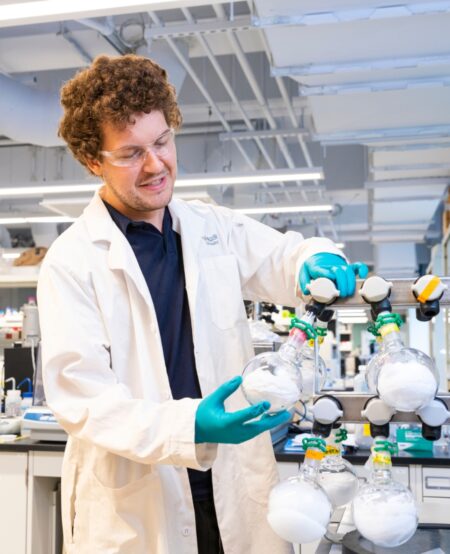
A person wearing a lab coat holds a round-bottomed flask up to a frame.

What you'll learn

Study an interdisciplinary field that combines chemical engineering principles with biomedical applications to design and improve processes, materials, and technologies that impact human health.

You’ll build a strong foundation in core areas such as thermodynamics, transport phenomena, reaction engineering, and materials science, while exploring biomedical applications including biomaterials, bioprocesses, and medical technologies.

The Chemical Engineering and Biomedical Engineering program is offered by the Department of Chemical Engineering and the Department of Biomedical Engineering.

All students in McMaster’s Integrated Biomedical Engineering & Health Sciences (iBioMed) program participate in a common first year — IBEHS 1. Build a solid base in the fundamentals of engineering, health and entrepreneurship and get exposed to design work at the start of your degree.

CHEMENG 3G04 – Chemical Process Design and Simulation  

Learn how real industrial processes are designed and optimized using professional simulation tools.

IBEHS 4M03 – Biomaterials and Tissue Engineering

Explore how engineered materials interact with the human body while investigating how tissues can be designed, repaired, or replaced for medical applications.

CHEMENG 3P04 – Process Control

Learn how engineers keep real-world systems stable and efficient by designing control strategies used in chemical plants, manufacturing, and biomedical systems.

Get practical experience and grow your portfolio with interdisciplinary design courses. All students in Integrated Biomedical Engineering and Health Sciences take six project-based design courses:

1. IBEHS 1P10 A/B – Health Solutions Design Projects I: Introduction to Engineering Fundamentals and Design 

2. IBEHS 2PA2 – Health Solutions Design Projects II-A: Lab Skills in Genetic Engineering

3. IBEHS 2PB2 – Health Solutions Design Projects II-B: Project in Genetic Engineering

3. IBEHS 3P04 – Health Solutions Design Projects III: Economic Analysis and Risk Management

4. IBEHS 4P03 – Health Solutions Design Projects IV: Decision Making and Project Management

5. Capstone project (year-long design project)

Potential career paths

Graduates will be career-ready for high demand areas such as process design, energy systems, materials and industrial operations: 

  • Chemical engineer
  • Environmental engineer
  • Manufacturing engineer
  • Operations performance engineer
  • Process engineer
  • Quality engineer
  • Research and development engineer
  • Biomedical startup founder
  • Healthcare innovation consultant

Explore Chemical and Biomedical Engineering in grad school

You’ll already be connected to world-renowned researchers leading innovation in your undergrad: continue pursuing research and innovation in a master’s program.

  • The largest undergraduate research program in the Faculty

    With the largest undergraduate research program in the Faculty of Engineering, Chemical Engineering provides unmatched opportunities for experiential learning.

    Students can engage in research early, building valuable skills, professional connections and a competitive edge for future careers or graduate studies.
  • Clubs and teams

    McMaster has many clubs, teams and societies you can join to practice your engineering skills, get more hands-on experiences and explore new activities.
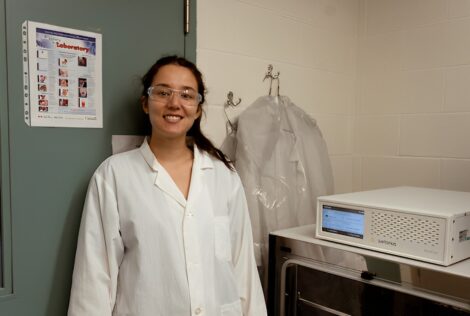
    The Chem-E-Car Team designs and builds a chemically powered car that runs on controlled reactions, competing in engineering challenges focused on performance, safety, and design innovation, earning 1st place at the 2025 North America Central Regionals.
    Learn more about Mac Eng Experiences
  • Research in action

    Engage in hands-on research and complex problems with a mentor as early as your first year.

    A Chemical Engineering student helped develop an inexpensive vaccine stabilization method that dissolves easily and avoids cryogenics, improving vaccine distribution in low-resource regions and leading to a start-up!

More helpful links