

The newly released Energy Harvesting Study from Hamilton Community Enterprises (HCE) has affirmed that the future of sustainable energy solutions in Hamilton is bright.
This two-year study, developed in collaboration with community members from various sectors, including McMaster University, examines the feasibility of establishing a thermal corridor that could link Hamilton’s Bayfront Industrial Area to buildings along a five kilometre route extending into downtown and beyond.
A thermal corridor is a main trunk line of thermal network infrastructure that connects neighbourhoods of many heating dominant buildings to large waste heat sources, such as industrial zones.

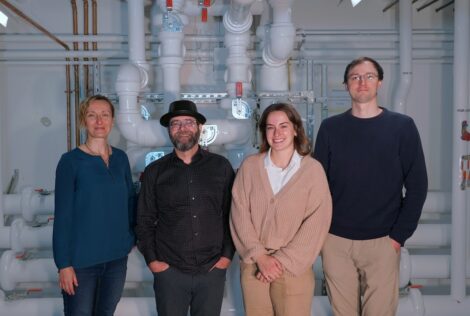
McMaster University’s Study submission was conducted by a team of Master of Engineering and Public Policy students, Rebecca Korolnek, Shivani Nathoo and Mahdiyar Qajar, led by associate professor and program lead Greig Mordue. The team added a crucial public policy perspective to the multi-year study, exploring the potential of using waste heat from manufacturers in Hamilton’s Bayfront Industrial Area to power a district energy system.
Mechanical engineering professor Jim Cotton and integrated energy systems research engineer Kelton Friedrich from the McMaster Institute for Energy Studies (MIES) also contributed significantly to the overall report submission. Cotton is a world-renowned leader in energy harvesting, and the CEO and founder of HARvEST Systems, a leader in sustainable energy solutions launched out of McMaster Engineering.
Hamilton, and more broadly Canada, are on the right track in stepping up investments in energy harvesting infrastructure for social good.
The future of achieving net-zero requires a community-wide approach
In addition to McMaster, community contributors include Mohawk College, City of Hamilton, Enbridge, ArcelorMittal Dofasco and the Hamilton Chamber of Commerce, highlighting a shared interest in and potential wide impact of the proposal.
If a thermal corridor is actioned, the study found that it could have the potential to support the decarbonization of over 80 million square feet of building space, reduce greenhouse gas emissions by 80% compared to fossil fuel heating – more than 27,000 tonnes annually, avoid $247 million in new electrical infrastructure costs over 10 years and generate $12–33 million in additional profits for local industry.
“Communities worldwide are tapping into locally available sources of waste heat to operate thermal networks that are cleaner, resilient and more efficient,” said Cotton, who is also Co-Director of MIES. “Hamilton, and more broadly Canada, are on the right track in stepping up investments in energy harvesting infrastructure for social good. Heating from buildings is one of the top sources of carbon emissions and the opportunity to help decarbonize our society should be accessible for all.”