Health, Engineering Science & Entrepreneurship (HESE) Program – Faculty of Engineering

Health, Engineering Science & Entrepreneurship (HESE) Program  

A unique integrated program delivered jointly by the Faculties of Engineering and Health Sciences, where students are required to complete core project- and design-based courses from the iBioMed program in addition to courses that integrate business and engineering.


Length
4 years
Degree
Bachelor of Health Sciences (Co-op Available)
Program
Integrated Biomedical Engineering & Health Sciences (iBioMed)
Options

Co-op


Overview

Health, Engineering Science and Entrepreneurship (HESE) integrates health sciences, engineering, and business to develop innovative solutions to real healthcare challenges. Through hands-on projects, clinical collaborations and experiential learning in healthcare settings, you’ll explore human health, medical technology design, innovation and commercialization.

Graduates are prepared for careers in medical devices, biotechnology, digital health, healthcare consulting and healthcare entrepreneurship across the health and life sciences sectors.
Why study this program?

  1. Canada’s first program to integrate engineering, entrepreneurship and health sciences, preparing students to develop innovative solutions that improve health and technology.
  2. Learn alongside clinicians from day one. Work with healthcare professionals to identify real clinical challenges, then design innovative solutions through hands-on projects and clinical placements.
  3. Graduate with the technical, clinical, and entrepreneurial experience to pursue careers in medical devices, biotechnology, digital health, healthcare consulting, startups or advanced studies in medicine, engineering or business.
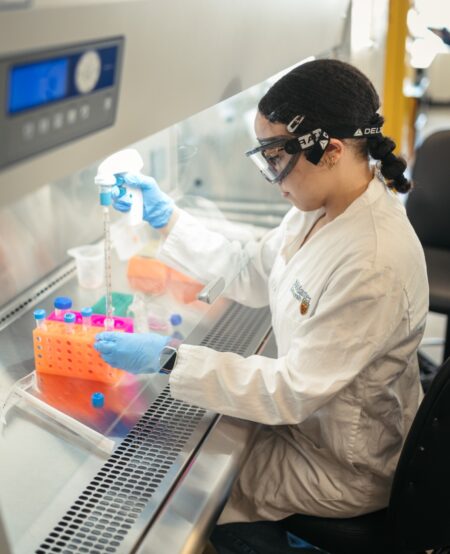
A person wearing safety glasses conducts an experiment within a lab fume hood.

What you'll learn

Study an interdisciplinary field that integrates health sciences, engineering and entrepreneurship to address real-world healthcare challenges. You develop foundational knowledge in human health and disease, alongside skills in engineering design, data-driven problem solving and innovation. The curriculum spans clinical exposure, medical technology development and healthcare systems, with opportunities to explore medical devices, digital health solutions and pathways to commercialization.

The Health, Engineering Science and Entrepreneurship program is offered by the Department of Health Sciences.

All students in McMaster’s undergraduate engineering programs participate in a common first year — Engineering 1. Build a solid base in the fundamentals of engineering disciplines and get exposed to engineering design work right at the start of your degree.

IBEHS 3E03 – Fundamentals of Business Strategy

This course exposes students to the key business management skills and strategies needed to start a successful enterprise in Canada. Topics covered include: Start-up Financing, Marketing, Forecasting, Intellectual Property and Budgeting.

IBEHS 4EE6 A/B – Innovators in Scrubs

Gain immersive, hands-on exposure to clinical environments while working directly with healthcare professionals. You’ll observe real patient care and identify unmet needs that can inspire new engineering and entrepreneurial solutions.

IBEHS 4F04 – Biomedical Instrumentation and Measurement

Explore how medical devices are designed to measure and monitor the human body. Through labs and applied projects, you’ll work with biomedical sensors, instrumentation systems, and data used in clinical diagnostics and care.

Get practical experience and grow your portfolio with interdisciplinary design courses. All students in Health, Engineering Science and Entrepreneurship take five project-based design courses:

1. IBEHS 1P10 A/B – Health Solutions Design Projects I: Introduction to Engineering Fundamentals and Design 

2. IBEHS 2PA2 – Health Solutions Design Projects II-A: Lab Skills in Genetic Engineering

3. IBEHS 2PB2 – Health Solutions Design Projects II-B: Project in Genetic Engineering

3. IBEHS 3P04 – Health Solutions Design Projects III: Economic Analysis and Risk Management

4. IBEHS 4P03 – Health Solutions Design Projects IV: Decision Making and Project Management

Potential career paths

Graduates will be career-ready for high-demand roles in biotechnology, medical device innovation, digital health, healthcare consulting, pharmaceuticals, and health technology startups, with many graduates also pursuing graduate studies, medical school, or other professional graduate programs.

  • Healthcare
  • Medical equipment manufacturing
  • Medical labs
  • Medical practices and services
  • University researcher

Explore Health, Engineering Science and Entrepreneurship in grad school

You’ll already be connected to world-renowned researchers leading innovation in your undergrad: continue pursuing research and innovation in a master’s, MD/PhD or PhD program.

  • Clubs and teams

    The Society for the Health Engineering Science Entrepreneurship offers a range of resources and activities that aim to support and inspire HESE students, including the Research Launch Pad, Thesis Nights and social events like karaoke!

    Learn more about Mac Eng Experiences
  • iGEM

    iGEM is a highly accomplished international synthetic biology competition aimed primarily at undergraduates, with the involvement of students, professors, and various stakeholders. Interdisciplinary teams specializing in Wet Lab, Dry Lab, and Human Practices collaborate to create novel synthetic biology oriented projects that can be applied in the real world!

    Learn about undergrad research opportunities

More helpful links