Chemical Engineering – Faculty of Engineering

Chemical Engineering

Master the principles of chemical engineering to innovate in material manufacturing, energy development, and product creation.

Length
4 years
Degree
Bachelor of Engineering (Co-op Available)
Program
Engineering
Options

Co-op, Management, Society

Overview

Explore how chemical engineering transforms raw materials into the products people rely on every day. Through hands-on labs and design projects, you’ll study process design, energy systems, safety, sustainability and production technologies used in industries such as food, pharmaceuticals, clean water and consumer goods.

Graduates are prepared for diverse careers focused on creating efficient, environmentally responsible solutions that improve quality of life.

Why study this program?

  1. Gain hands-on experience through industry-based capstone projects, undergraduate research opportunities, and award-winning student design teams  
  2. Benefit from an average of ~80 students per lecture and 20-25 per tutorial, ensuring a more personalized, supportive, and interactive learning experience  
  3. Access one of the largest undergraduate research programs in the Faculty, with opportunities for paid research experience alongside faculty on cutting-edge projects
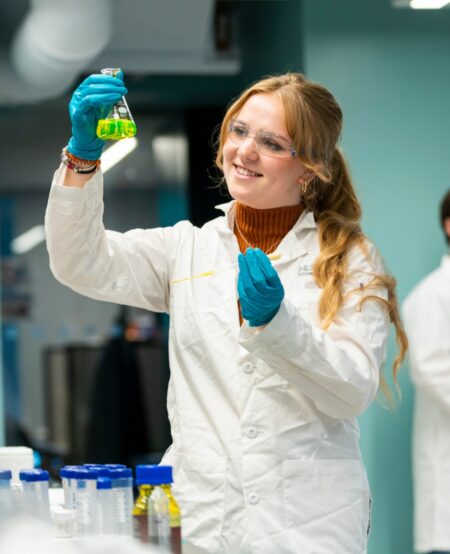
A student wearing safety glasses raises a beaker with liquid up in the air.

What you'll learn

Study the environmentally responsible production of chemicals used across nearly every industry.

You can focus your learning through electives in sustainable water and energy technologies, polymer materials and manufacturing, or process systems engineering, exploring topics such as energy system design, polymer synthesis and processing, industrial separations, and plant optimization.

The Chemical Engineering program is offered by the Department of Chemical Engineering.

All students in McMaster’s undergraduate engineering programs participate in a common first year — Engineering 1. Build a solid base in the fundamentals of engineering disciplines and get exposed to engineering design work right at the start of your degree.

CHEMENG 2D04 – Chemical Engineering Principles I

CHEMENG 2F04 – Chemical Engineering Principles II

Learn the fundamental of chemical engineering including material and energy balances, that can help you explore and design industrial processes.

CHEMENG 3G04 – Chemical Process Design and Simulation

Learn how real industrial processes are designed and optimized using professional simulation tools.

CHEMENG 4N04 – Engineering Economics and Problem Solving

Learn the applications to design and operation of engineering systems, emphasizing safety, equipment performance, uncertainty, flexibility and troubleshooting.

Get practical experience and grow your portfolio with interdisciplinary design courses. All students in a Bachelor of Engineering take project-based design courses:

1. ENGINEER 1P13: Integrated Cornerstone Design Projects in Engineering

2. ENGINEER 3PX3: Engineering Design 2: Engineering Economics

3. Capstone project (year-long design project)

Potential career paths

Graduates will be career-ready for high demand areas such as process design, energy systems, materials and industrial operations: 

  • Chemical engineering
  • Environmental engineering
  • Interfacial engineering
  • Manufacturing engineering
  • Nanotechnology
  • Operations performance engineering
  • Process engineering
  • Quality assurance analysis
  • Research and development

Explore Chemical Engineering in grad school

You’ll already be connected to world-renowned researchers leading innovation in your undergrad: continue pursuing research and innovation in a master’s program.

  • The largest undergraduate research program in the faculty

    With the largest undergraduate research program in the Faculty of Engineering, Chemical Engineering provides unmatched opportunities for experiential learning.

    Students can engage in research early, building valuable skills, professional connections and a competitive edge for future careers or graduate studies.
  • Clubs and teams

    McMaster has many clubs, teams and societies you can join to practice your engineering skills, get more hands-on experiences and explore new activities.
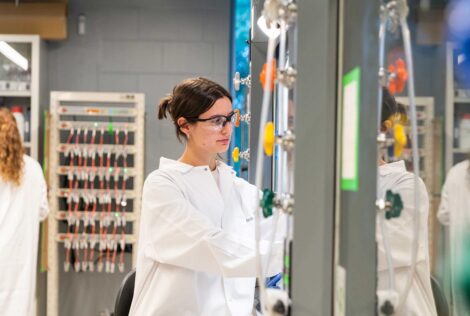
    The Chem-E-Car Team designs and builds a chemically powered car that runs on controlled reactions, competing in engineering challenges focused on performance, safety, and design innovation, earning 1st place at the 2025 North America Central Regionals.
    Learn more about Mac Eng Experiences
  • Research in action

    Engage in hands-on research and complex problems with a mentor as early as your first year.
    A Chemical Engineering student helped develop an inexpensive vaccine stabilization method that dissolves easily and avoids cryogenics, improving vaccine distribution in low-resource regions and leading to a start-up!
Red and white flowers blooming on campus

Upper-year specializations

Specialized programs at McMaster can take your Engineering degree to the next level.

At the end of your first year in Engineering, you can apply to two other exciting options:

  • Engineering & Management
  • Engineering & Society
Here are further details to help you imagine your McMaster future.

Become a leader that solves complex challenges with your technical and business expertise in this five-year program.

Once you’ve completed first year requirements in good standing, you can apply to this program.

Follow your passion in Engineering & Society. Combine your engineering education with a deeper understanding of human-centred design and problem-solving skills in this five-year program.

Once you’ve completed first year requirements in good standing, you can apply to this program.

More helpful links