
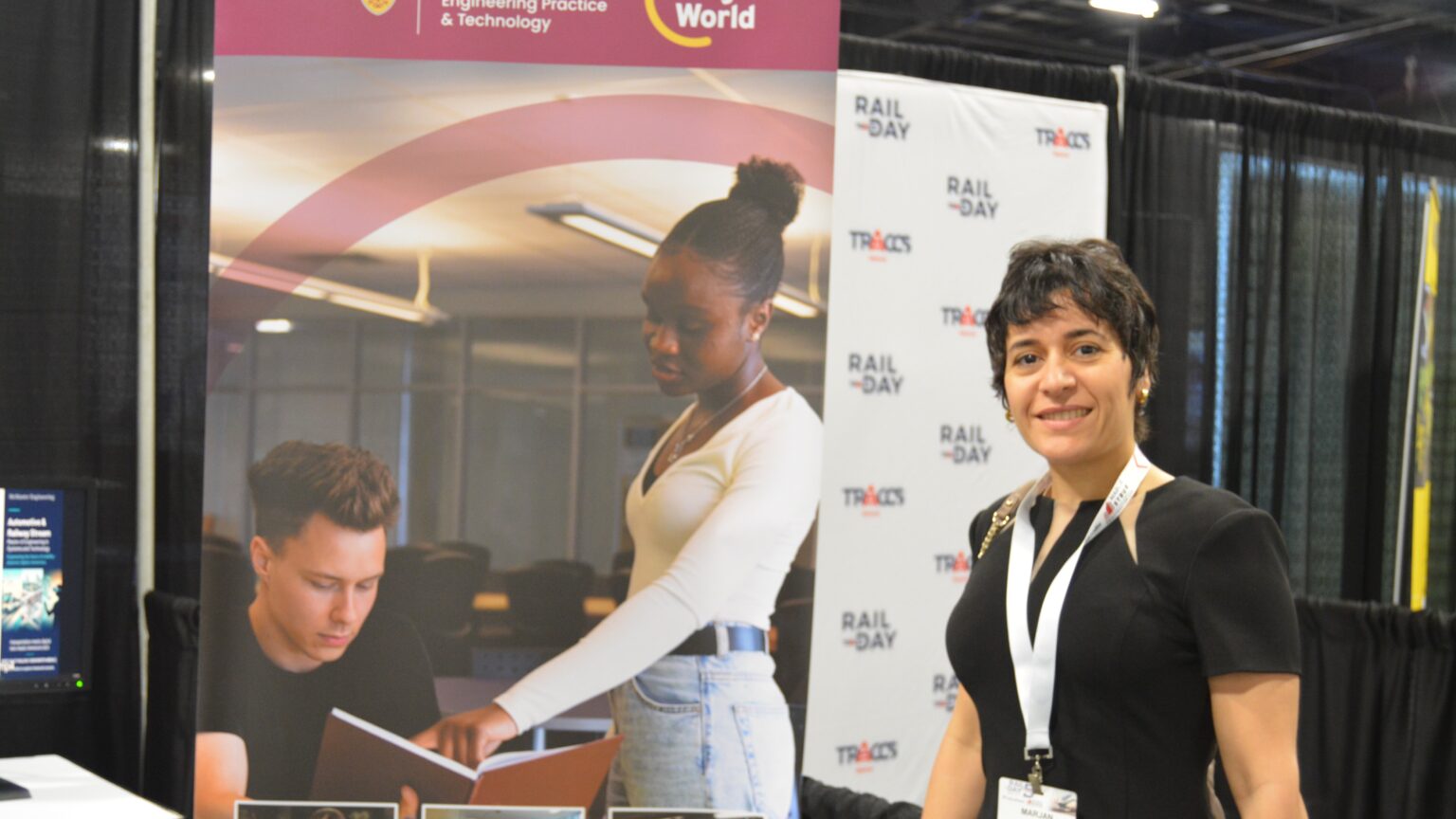
When industry leaders began identifying a shortage of engineers with railway-specific expertise, Marjan Alavi saw an opportunity.
As Lead for McMaster Engineering’s Master of Engineering Systems and Technology, Alavi worked with industry partners to help turn that need into action through McMaster’s new Graduate Academic Certificates in Railway Engineering. The programs were developed to prepare learners for a sector undergoing significant change as investments in rail infrastructure and transportation modernization continue to grow.
In celebration of International Women in Engineering Day, we sat down with Alavi to discuss her career, the importance of representation in engineering, and the opportunities she sees ahead for the next generation of railway professionals.
This year’s Women in Engineering theme celebrates the leadership, creativity and expertise of women engineers. How have these qualities influenced your own career and your work to date?
Leadership, creativity, and technical expertise have been central to my career. As an educator and engineering leader, I have often found myself working at the intersection of emerging technologies, industry needs and student development. Leadership has enabled me to bring together industry, academia and professional organizations to create new opportunities for students. Creativity has been essential in designing innovative educational programs and solving complex engineering challenges. Technical expertise provides the foundation that allows these ideas to be translated into practical solutions. Throughout my career, I have focused on building bridges between disciplines, institutions and people to create meaningful impact in engineering education and practice.
You were the driving force behind McMaster’s new Graduate Academic Certificates in Railway Engineering. What inspired you to develop these programs, and who else is involved?
The idea emerged from conversations with industry partners who consistently identified a shortage of engineers with railway-specific knowledge. Canada is investing heavily in rail infrastructure, electrification, signaling and transportation modernization, yet there are very few opportunities for specialized railway education. Working closely with industry partners, including Wabtec, Hitachi Rail, HNTB, and WSP, we developed a suite of graduate-level courses and certificates that address these workforce needs. The certificates provide flexible pathways for both recent graduates and working professionals to acquire specialized knowledge in railway systems. This initiative has been a collaborative effort involving faculty colleagues, industry experts and academic leaders who share a vision for strengthening Canada’s railway talent pipeline.
Railway systems are becoming increasingly complex. What are some of the biggest challenges facing the industry today, and how can our certificates help to solve them?
Modern railway systems integrate infrastructure, signaling, communications, electrification, cybersecurity, data analytics, and increasingly, artificial intelligence. One of the industry’s biggest challenges is finding engineers who understand how these interconnected systems work together. Another challenge is managing the transition toward digitalization and sustainable transportation while maintaining safety and reliability. Our certificates were designed to address these needs by providing interdisciplinary education that combines technical fundamentals with practical industry perspectives. Graduates will be better equipped to contribute to the design, operation, maintenance and modernization of railway systems.
Railway engineering has traditionally been a male-dominated field. How have you seen the role of women in the industry evolve, and why does representation matter?
Over the past decade, I have seen a growing number of women taking on leadership roles across engineering and transportation sectors. While there is still work to be done, organizations are increasingly recognizing the value of diverse perspectives in solving complex problems. Representation matters because it allows future generations to see themselves in these careers. When women are visible as engineers, researchers, project managers, and executives, they help broaden the talent pool and bring new perspectives to innovation. Diversity is not only about fairness, it is also a driver of better decision-making, creativity and organizational success.

What excites you most about the future of railway engineering, and the role McMaster graduates can play in shaping it?
Railway engineering is entering a period of remarkable transformation. Advances in electrification, automation, artificial intelligence, predictive maintenance, digital twins, and smart infrastructure are changing how railway systems are designed and operated. What excites me most is the opportunity to train engineers who can lead this transformation. McMaster graduates are uniquely positioned because they develop both technical expertise and systems-thinking skills. They understand how to integrate technology, safety, sustainability and human factors to solve real-world challenges. I am excited to see our graduates contribute to building safer, smarter, and more sustainable transportation systems for the future.
Learn more about our new Graduate Academic Certificates in Railway Engineering:
Graduate Academic Certificate in Rail Electrification and Signalling
Graduate Academic Certificate in Rail infrastructure and Operations
Graduate Academic Certificate in Railway Systems and Assurance