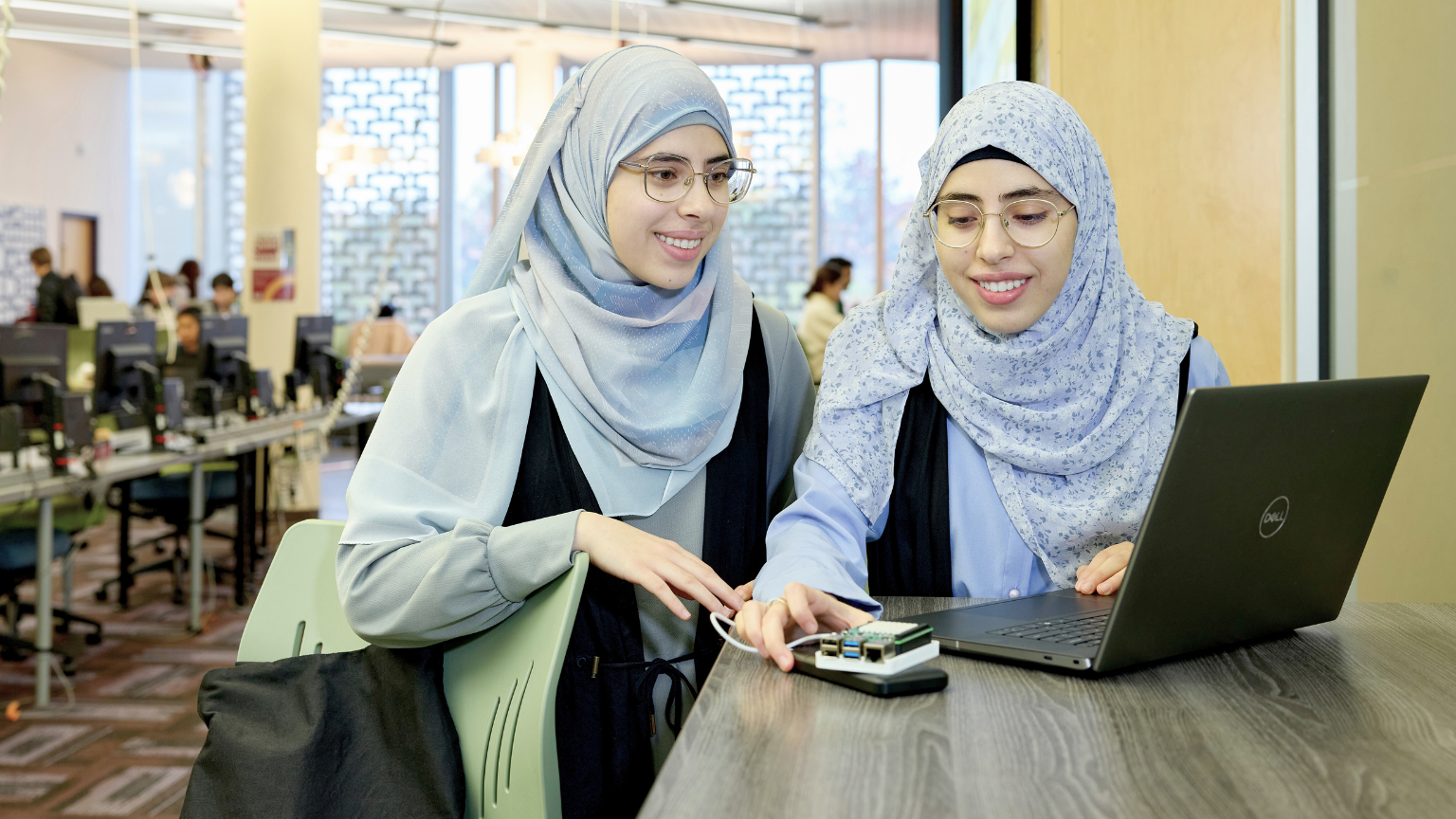
Razan and Rawaan Abu-Shaera share more than just a birthday. They’re both studying Mechatronics and Biomedical Engineering (iBioMed) at McMaster University.
Navigating university with a twin has its perks. For starters, you have a “built-in study buddy,” as Rawaan puts it. Though they may not always agree with each other, they make sure to celebrate their wins, push each other and offer honest feedback.
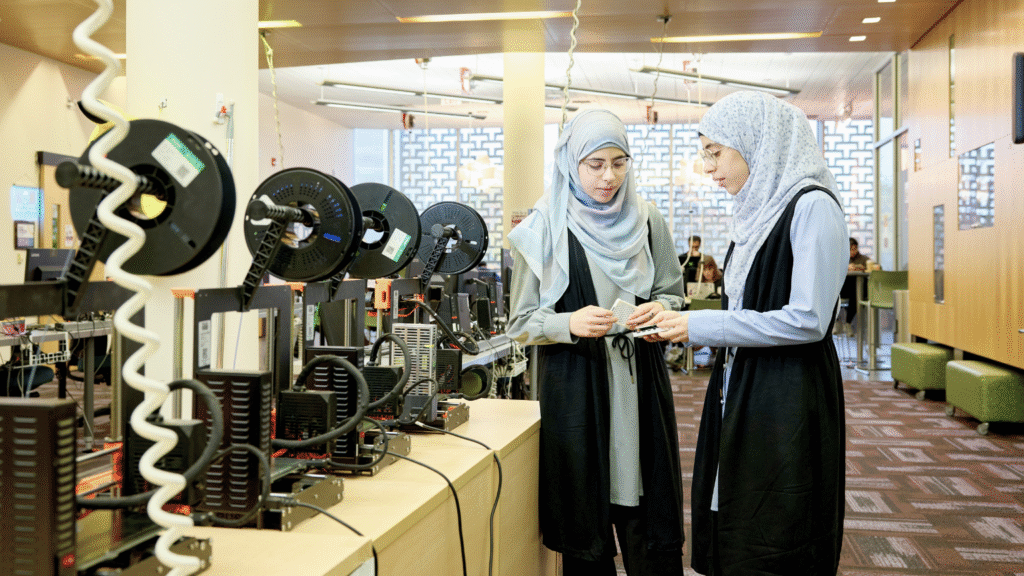
In their fifth and final year, they’ve taken the same classes, written the same exams and tackled many of the same hands-on projects.
And now, they’re adding one more shared milestone to the list: launching a startup.
Engineering is all about teamwork. Our specialization in Mechatronics allows us to be the piece that connects all the other pieces together.
Innovative from the start
The sisters’ entrepreneurial journey began in first year with a project that evolved into Biomedtrix Innovations Inc., an early-stage digital health startup. Its flagship product, PalmFree, is an interactive therapy game designed to help patients with mobility deficits regain hand function.
“We worked with a client with multiple sclerosis who had spasticity in her dominant hand,” says Razan. “Our goal was to create a fun way to build dexterity in her non-dominant hand.”
The prototype won Best Prototype Award at the 2022 iBioMed Showcase. Through McMaster’s Residency @ The Clinic program, they refined PalmFree to address gaps in stroke rehabilitation and built a strong mentor network. Their efforts earned the People’s Choice Award for Most Innovative Technology.
Today, PalmFree is preparing for clinical trials in early 2026 in collaboration with Hamilton Health Sciences’ Regional Rehabilitation Centre Stroke Unit. “We’re working to secure pre-seed funding to bring PalmFree to stroke survivors,” says Rawaan.
Putting their education to work
Believe it or not, the sisters had no coding experience when they started out, Rawaan recalls. “We didn’t even know what a breadboard was.” But that quickly changed.
“A highlight of our program is learning across electrical, software and mechanical engineering,” she says. “That interdisciplinary foundation gives us confidence to tackle problems.”
The sisters credit the program’s hands-on approach for their transformation. Rawaan points to the interactive labs, supportive instructors and real-world projects that gave them the skills to make real innovations.
“Engineering is all about teamwork,” says Razan. “Our specialization in Mechatronics allows us to be the piece that connects all the other pieces together.”
Looking to the future
Beyond their startup, Razan and Rawaan lead STEM workshops, teach coding to local elementary students and mentor McMaster teams advancing PalmFree’s technical and commercialization strategy.
Their contributions earned them the iBioMed Community Involvement Award, and they were recently honoured with the inaugural Lucy Casacia Catalyst Award for Women in Mechatronics. Casacia was a 1985 McMaster graduate of Materials Engineering eager to support women in engineering.
“We’re honoured to be recipients of this scholarship,” says Razan. “This award will support us as we continue our education.”
And speaking of the future, their collaboration won’t be ending any time soon.
Razan and Rawaan both plan to pursue graduate studies through McMaster’s Biomedical Engineering direct-to-Ph.D. program. While their paths may divert from there – Rawaan has her sights set on academia and Razan for R&D in the biomedical industry – they remain committed to their start-up and supporting one another as sisters, co-founders and confidantes.