
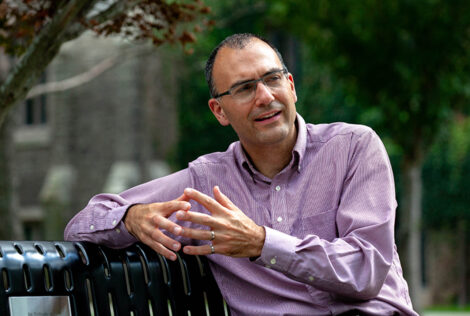
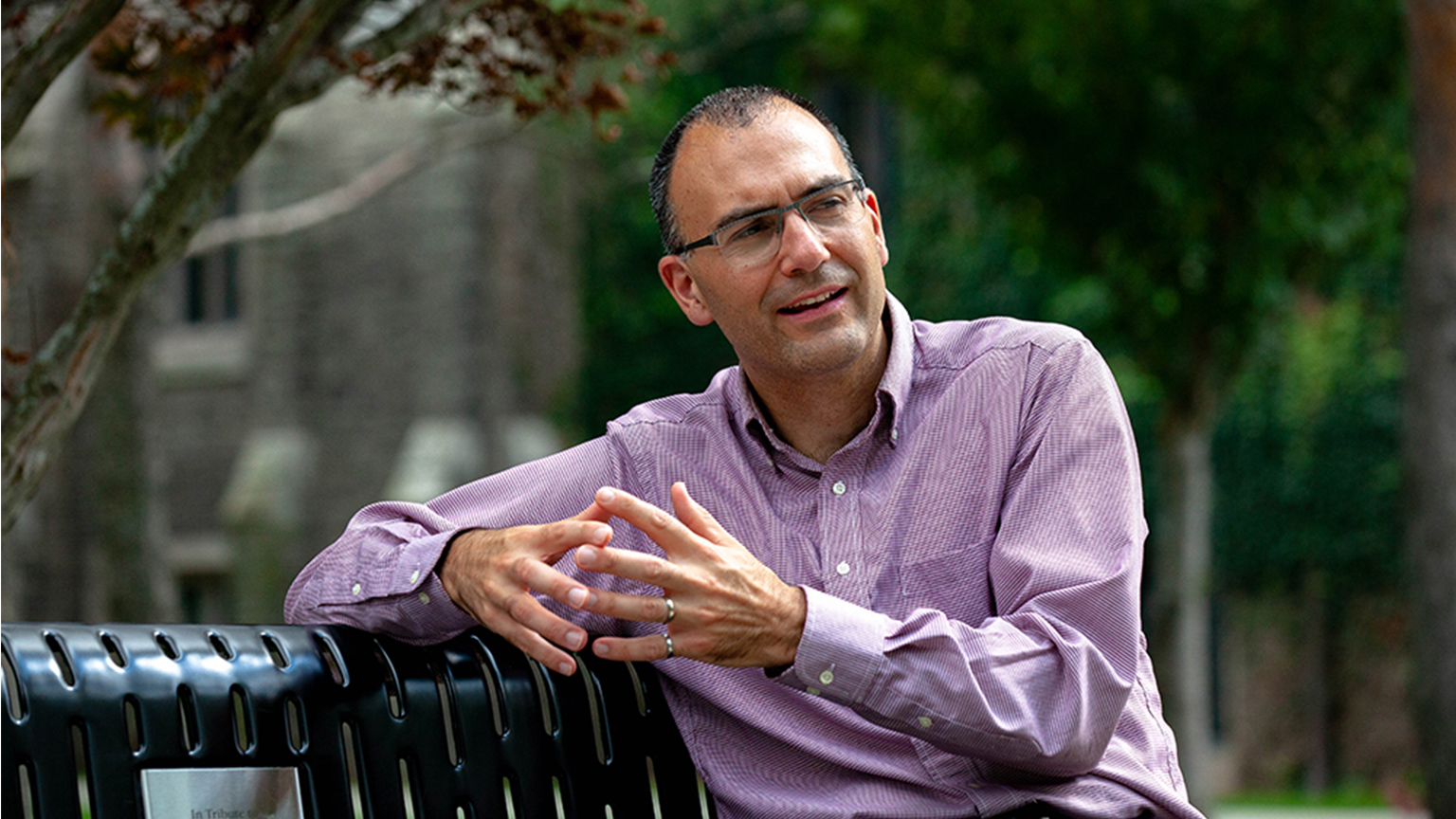
McMaster University researcher André Phillion has been awarded the 2026 MetSoc Distinguished Materials Scientist Award by the Materials Science and Engineering Section of The Metallurgy & Materials Society of the Canadian Institute of Mining, Metallurgy and Petroleum (CIM).
Phillion, a professor in McMaster’s Department of Materials Science & Engineering and the ArcelorMittal Dofasco Chair in Ferrous Metallurgy, has been recognized for his contributions to alloy solidification, microscopy, steelmaking and service to the materials community.
“I’ve spent much of my career trying to better understand how materials evolve during the manufacturing process because this process greatly determines performance later in service,” says Phillion. “To have that work recognized by MetSoc, an organization that represents a community I care deeply about, is genuinely an honour.”
Phillion’s group studies how alloys change while they are being made, with a specific focus on the process of solidification, in order to better control related industrial processes.
When liquid metal cools and becomes solid, explains Phillion, an enormous number of processes occur at a microscopic scale. Using advanced imaging methods and modelling tools, his group is able to observe these phenomena in real time. These include crystal growth, the formation of defects and changes to the material’s chemical composition. Understanding them is important because they ultimately determine whether a material becomes stronger, weaker, tougher or more reliable.
Many of these fundamental questions about solidification are explored in the context of continuous casting of steel, a major focus of Phillion’s research. Improving our understanding of this critical industrial process, he explains, can “improve steel quality and manufacturing efficiency, reducing waste and supporting”
To gain a more complete understanding of how materials behave across different length and time scales, Phillion’s group takes a “correlative approach” that combines multiple methods of observation, including high-temperature confocal microscopy to help observe microstructural evolution in real time while materials heat, melt or solidify; x-ray computed tomography (CT) to look inside materials in three dimensions without destroying them; and electron microscopy and chemical analysis to identify phases and composition at small length scales.
Phillion, who works closely with other academics, industry partners and professional societies, says that the highly collaborative nature of materials science and engineering—and, in particular, the community-building takes place as a result of these collaborations—is what drives innovation forward.
“Strong communities like materials science and engineering help move ideas into industry faster, create opportunities for trainees and ensure that research addresses real-world challenges,” he says. “This award feels like recognition of not only my research successes, but also my approach to connecting fundamental science with industrial relevance, while placing a great emphasis on mentoring graduate students and contributing meaningfully to the materials and metallurgy community worldwide.”