If members of the MacSmiths club ever found themselves in a precarious situation in the jungle, needing to cut through dense brush and unforgiving terrain, they would have the blade for the job.
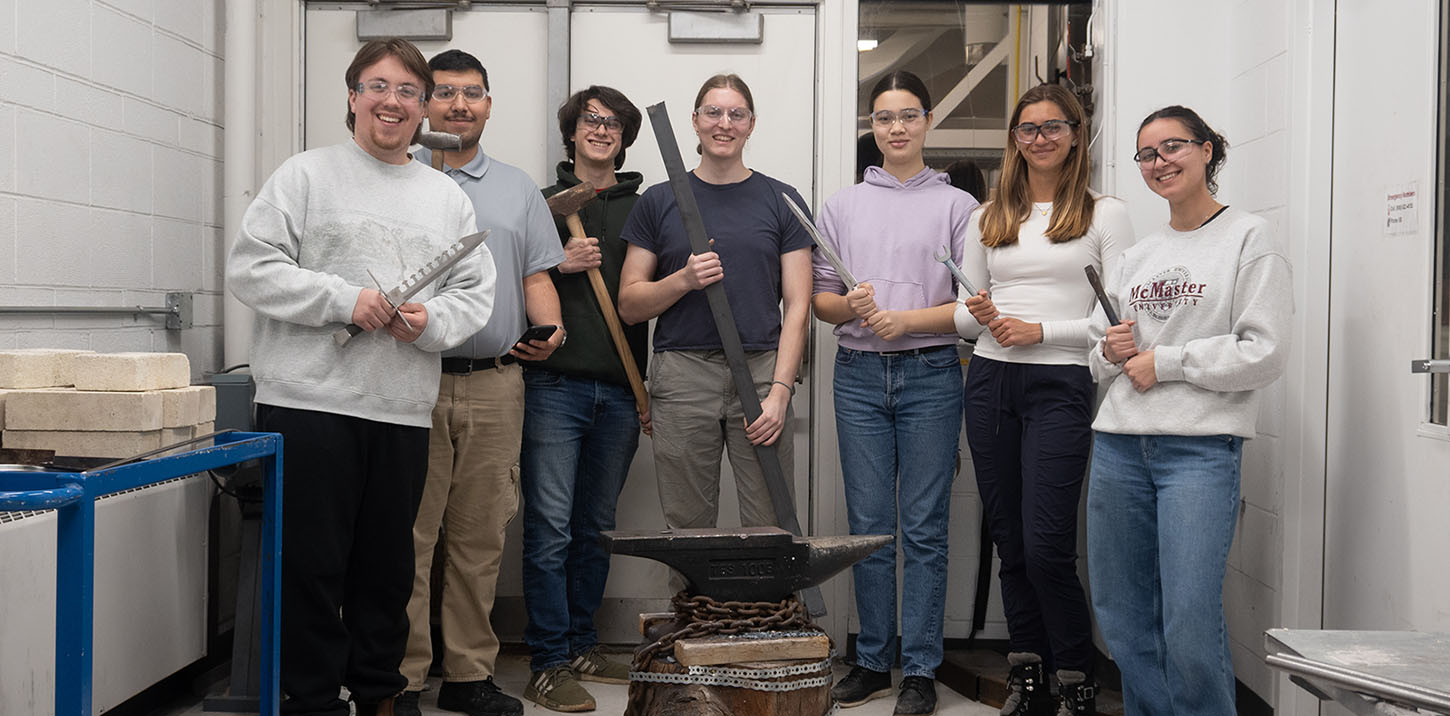
The McMaster University team — primarily made up of Materials Engineering and Mechanical Engineering students — forged the Astroknife, a blade inspired by those carried aboard NASA’s Apollo missions.
“It’s a part of their survival kits,” says MacSmiths member, student Bryson Carey. “If the capsule hurtling back down to Earth landed somewhere other than water, it was meant to be a reliable survival tool.”
Designed to withstand extreme conditions, the blade is a nod to aerospace history and modern materials engineering expertise.
Forged in McMaster’s Blacksmithing Lab, the Astroknife made its debut in March at The Minerals, Metals and Materials Society (TMS) Bladesmithing Competition in San Diego, California, where the MacSmiths earned second place overall among 26 universities — the team’s strongest showing in more than a decade.
A biannual bladesmithing tradition
For the MacSmiths, bladesmithing is far more than shaping steel with a hammer.
“We’re a blacksmithing and material science team, so we kind of have two parts,” explained team captain Jess Kuper. “We host forging sessions that are more casual, and then every other year we do the bladesmithing competition, where we forge a blade and complete a full material science and engineering report.”
That report includes mechanical testing, heat treatment analysis, microscopy and corrosion studies — all grounded in classroom theory but carried out in real-world conditions.
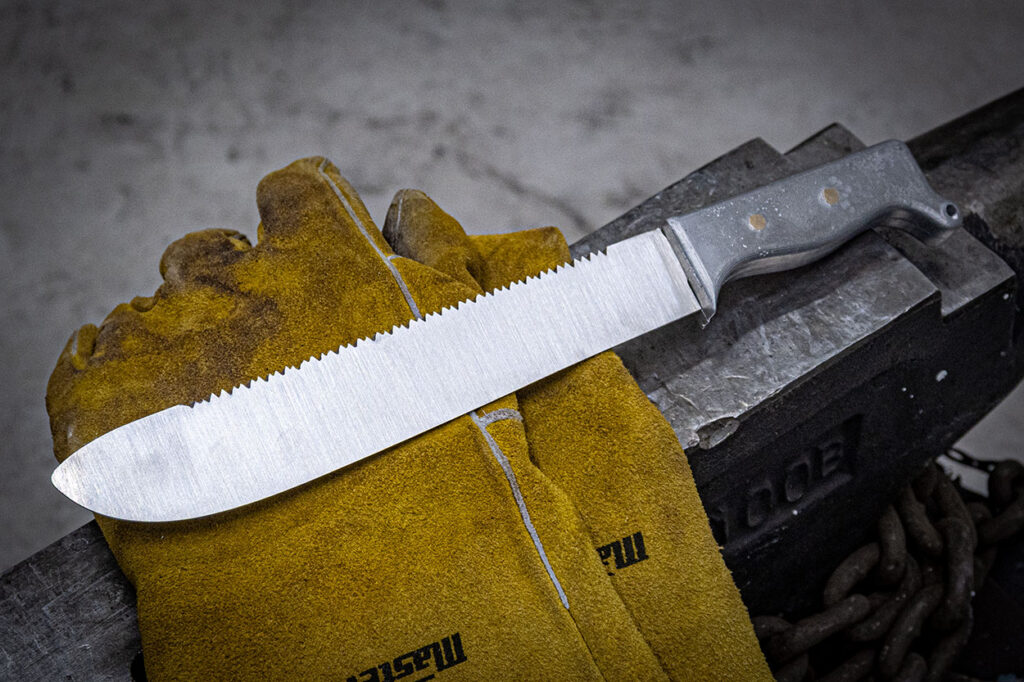
“What we ended up making our blade out of was maraging 350,” said Joseph Stein-Muise, referring to a high-strength, precipitation-hardened steel commonly used in aerospace applications.
“A big part of materials science is the correlation between processing, microstructure and final properties — so we were really seeing how what we did to the steel affected the microstructure, and how that microstructure affected the final blade.”
The experiential learning edge
For many team members, the MacSmiths provided meaningful hands-on experience rarely found in traditional coursework.
“There aren’t a lot of teams where you can really get hands-on and apply what we’re learning in class,” said Stein-Muise. “Especially with heat treatment and phase transformations — we’re pulling directly from theory and applying it to make a better blade.”
Mechanical Engineering student Julia Fletcher echoed that sentiment.
“Smithing is an application of forging, which is one of the most important manufacturing methods mechanical engineers use,” she said. “It was amazing to get that hands-on experience and work with such a unique material.”
The team operates out of a dedicated space equipped with a propane forge, 100-pound anvil and belt grinder, while also leveraging McMaster’s advanced facilities.
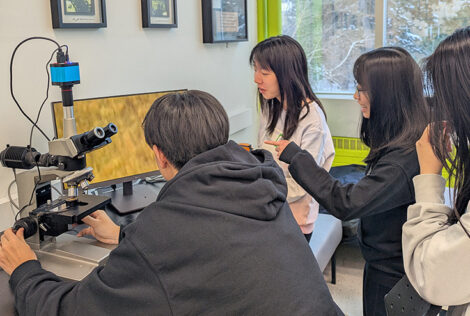
“We had access to all the materials engineering labs, mechanical testing equipment, and the Canadian Centre for Electron Microscopy (CCEM),” said Kuper.
That access proved critical.
“When we looked at samples macroscopically, we didn’t see much difference,” said Michelle Radoiu, who brought her undergraduate research experience at the CCEM to the MacSmiths. “But under the electron microscope, you could see a world of difference in the morphology. Slight changes in heat treatment made huge changes in the structure.”
A team forged on trust and complementary strengths
With students spanning materials science, mechanical engineering and research backgrounds, collaboration was key.
“One of the reasons our team did so well is because we all trusted each other,” said Carey. “We all had our own piece we could contribute — corrosion, microscopy, manufacturing, modelling — and we leaned into each other’s strengths.”
That trust paid off when the team encountered unexpected roadblocks.
“Our material wasn’t behaving the way we wanted it to,” said Kuper. “But our team member Jesus found a research article that allowed us to pivot and get really good results.”
For Jesus Delgado Ayala, the experience was as much about transferable skills as technical ones.
“A team like MacSmiths is all about community and cultivating a sense belonging,” he said. “We’re like-minded people investing in working toward something bigger.”
A sharp showing at TMS
The competition was held during the TMS Annual Meeting and Exhibition, a 5,000-person international research conference where teams presented their blades alongside a 10-page technical paper, a poster and a five-minute video.
“There were 20 judges and over eight hours of judging,” said Olivia Dmitrovich. “Seeing schools like MIT, Purdue and Texas A&M — and then placing second — was surreal.”
The award ceremony underscored the scale of the achievement.
“It was at that moment we felt how big the competition really was,” said Radoiu. “It was such a rewarding moment seeing our work recognized.”
What stood out most to judges, according to the team, was McMaster’s fully student-driven process.
“We did everything ourselves,” said Carey. “Some schools bring in professional bladesmiths. We hand-forged everything in-house, and the judges really appreciated our engineering process and material selection.”
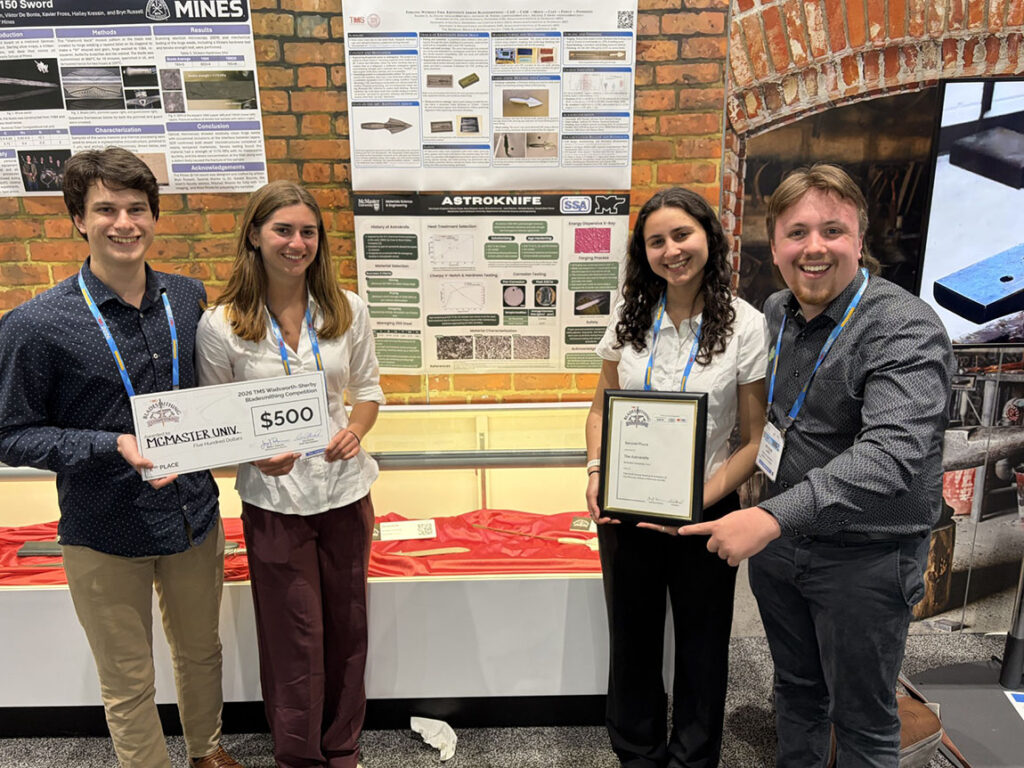
Professor Hatem Zurob, Chair of the Department of Materials Science and Engineering, highlighted the team’s growth. “We went from working in the corner of one lab to having a full-fledged forge,” he said. “Every year, our MacSmiths come up with a creative design. We have a very engaged and passionate group of students.”
The Astroknife will now be displayed in the Materials Engineering wing of the John Hodgins Engineering Building, joining past MacSmiths creations as a symbol of student ingenuity.
While bladesmithing may not be a career path for most team members, its impact is lasting.
“It’s a way to express creativity and apply what we’ve learned,” said Stein-Muise. “And it really opens your eyes to the breadth of what materials engineering can be.”