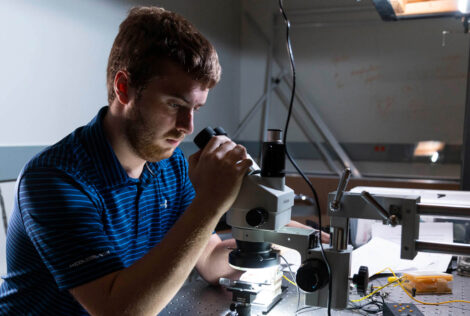
Our research explores the synthesis of novel semiconductor nanostructures and materials, and the development of next-generation optoelectronic devices and (bio)sensors based on these structures. Semiconductor nanostructures offer many advantages over conventional device structures based on planar heterostructures (planar layers grown on a bulk substrate). For example, while planar heterostructures are generally restricted to material combinations with similar lattice constants, the small size and mechanical flexibility of nanostructures allows for highly lattice-mismatched heterostructures to be realized, presenting the opportunity to fabricate heterostructures with previously prohibited materials combinations and strain states. This opens the door to a wide range of device applications and presents a promising route for integrating III-V materials (the basis for optoelectronic devices) on silicon (the basis for microelectronics and Si photonics).
A primary focus of our research is the self-assembly of nanostructures by molecular beam epitaxy (MBE) and metalorganic chemical vapor deposition (MOCVD). These are the primary deposition techniques used in research and industry to fabricate ultrapure single-crystal semiconductor layers, especially for optoelectronic devices. We seek to understand and then engineer surface, strain and size/quantum effects which are inherent to nanostructures, in order to realize novel heterostructures and devices with new properties and functionalities.
We are interested in:
III-V nanowires and quantum dots
Optoelectronic devices (light emitters and detectors) integrated with Si technology/photonics
Biosensors
Controlling nanostructure self-assembly using surface-energy-modifying surfactants
Exploring new phases and strain states of matter
Realizing heterostructures with dissimilar materials
Quantum materials and phenomena
Integrating III-V nanostructures on 2D materials
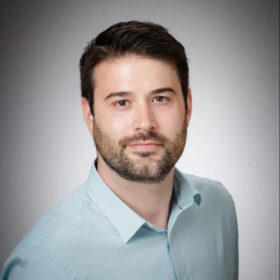
Dr. Ryan Lewis obtained his B.Sc. (Physics) from Dalhousie University, and his M.A.Sc. (Engineering Physics) and Ph.D. (Physics) from the University of British Columbia. From 2014–2018 he was a postdoc and Alexander von Humboldt guest scientist at the Paul Drude Institute for Solid-State Electronics in Berlin, Germany. Since the fall of 2018 Dr. Lewis has been an Assistant Professor of Engineering Physics at McMaster University.
Recent
Selected recent publications:
P. Corfdir, O. Marquardt, R. B. Lewis, C. Sinito, M. Ramsteiner, A. Trampert, U. Jahn, L. Geelhaar, O. Brandt and V. M. Fomin, “Excitonic Aharonov–Bohm Oscillations in Core–Shell Nanowires,” Advanced Materials31,1805645 (2019).
R.B. Lewis, P. Corfdir, H. Küpers, T. Flissikowski, O. Brandt and L. Geelhaar, “Nanowires bending over backward from strain partitioning in asymmetric core–shell heterostructures,” Nano letters18, 2343-2350 (2018).
R.B. Lewis, P. Corfdir, H. Li, J. Herranz, C. Pfüller, O. Brandt and L. Geelhaar, “Quantum dot self-assembly driven by a surfactant-induced morphological instability,” Physical Review Letters119, 086101 (2017).
R.B. Lewis, P. Corfdir, J. Herranz, H. Küpers, U. Jahn, O. Brandt and L. Geelhaar, “Self-assembly of InAs nanostructures on the sidewalls of GaAs nanowires directed by a Bi surfactant,” Nano Letters17, 4255−4260 (2017).
R.B. Lewis, L. Nicolai, H. Küpers, M. Ramsteiner, A. Trampert and L. Geelhaar, “Anomalous strain relaxation in core–shell nanowire heterostructures via simultaneous coherent and incoherent growth,” Nano letters17, 136-142 (2017).
Thin film growth and deposition including thermal evaporation, e-beam evaporation, sputtering, chemical vapour deposition and molecular beam epitaxy; thermodynamics and kinetics of film growth.
3 unit(s) An introduction to statistical distributions and their properties, and the statistical basis of thermodynamics at the microscopic level, with applications to problems originating in a modern laboratory or engineering environment.
Three lectures, one tutorial; second term
Prerequisite(s): Credit or registration in ENGPHYS 2NE3, ENGPHYS 2QM3, and ENGPHYS 3L04
LIST B: MECHATRONICS An introduction to quantum computing including qubits, entanglement, quantum key cryptography, teleportation, quantum circuits and algorithms, spin qubits. Three lectures; second term Prerequisite(s): ENGPHYS 2QM3 or PHYSICS 2C03