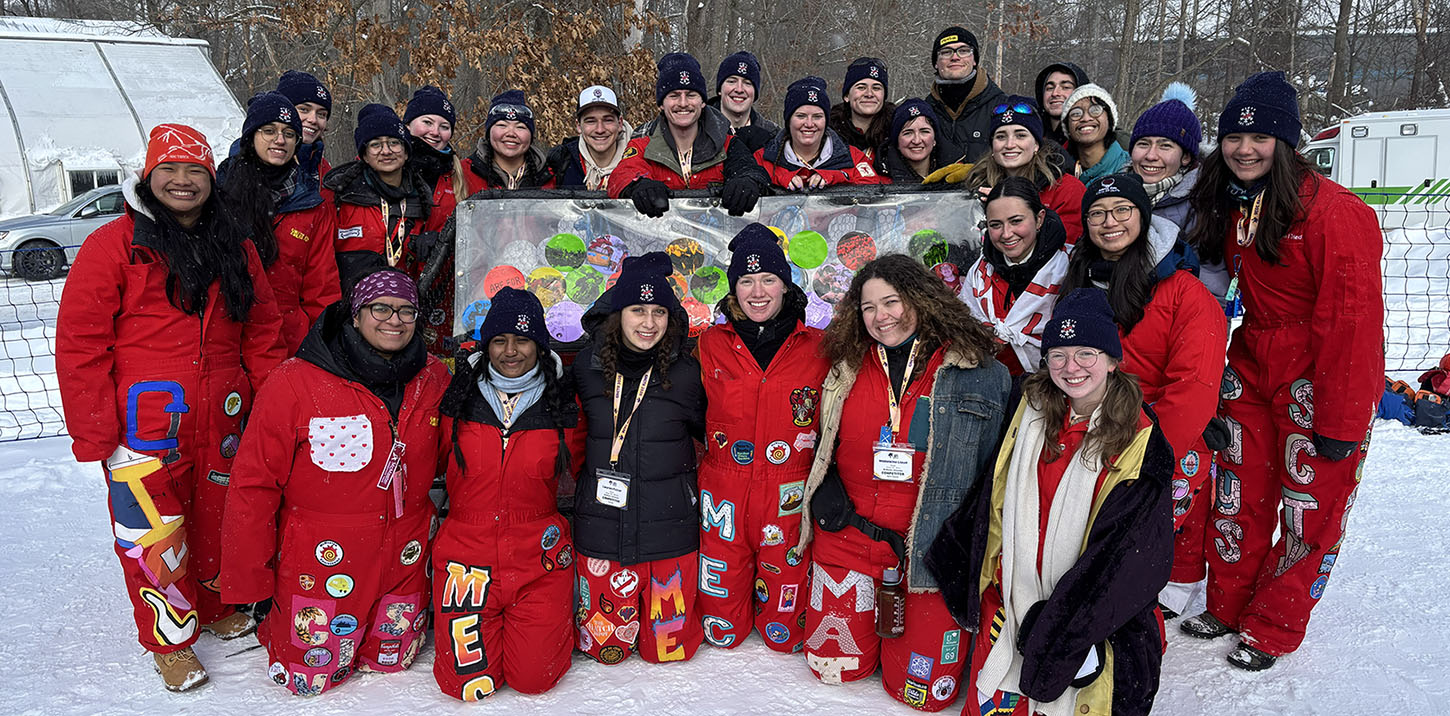
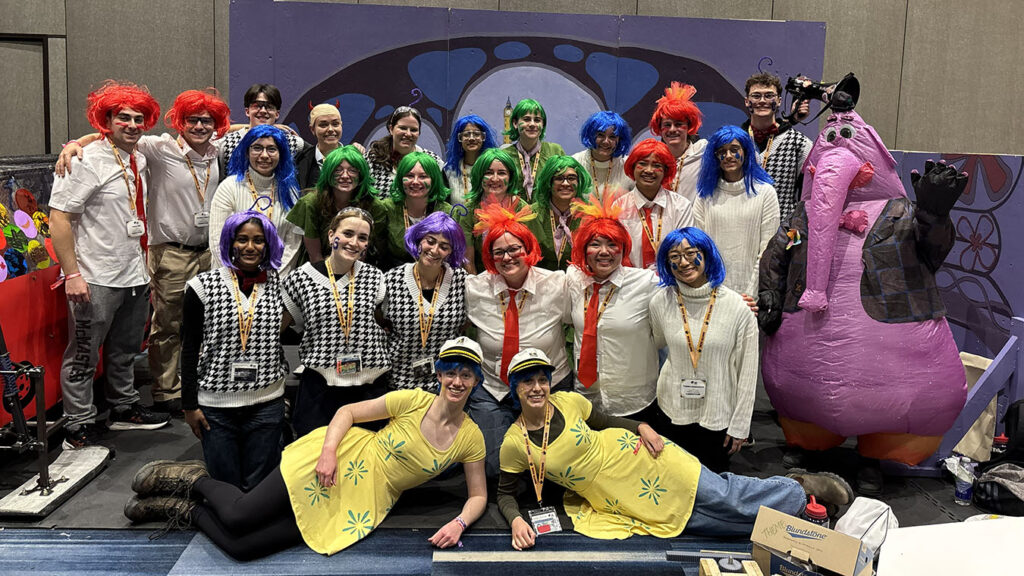
When the McMaster Engineering Concrete Toboggan Team (MECTT) chose Inside Out — or, more specifically, Insled Out — as their theme for the 2026 competition season, they couldn’t have known how closely the themes of the film would mirror their experience.
Anticipation, excitement, uncertainty, stress, relief and pride all came into play at the Great Northern Concrete Toboggan Race (GNCTR) in London, Ontario. GNCTR is the oldest engineering competition in North America, spans four days and brings together student teams from across the continent. After a technical exhibition and design judging, everything culminates on race day, when concrete sleds are finally put to the test on a ski hill.
What began with a strong performance for MECTT soon tested their resolve, but through it all, camaraderie and resilience kept them steady and resulted in nine awards, including first place in Technical Exhibition Display and Best Technical Report.
A strong start
Race day began on a high note during the drag race, which measures straight‑line speed and braking performance. With no opportunity for prior on‑hill testing, every run is a leap of faith. This year, that leap paid off.
The McMaster sled reached approximately 44 km/h, earning the second‑fastest time of the event, while the braking system performed exactly as designed.
“It was pure adrenaline,” said Japneet Cheema, a Civil Engineering and Society student and MECTT’s Concrete Sub-Captain. “You don’t even realize how fast you’re going — you’re just screaming out of excitement, knowing you’re riding something you built from scratch.”
When things go sideways
The emotional tone shifted quickly during the slalom run. Just moments before launch, as the driver tested the steering, a critical coupling snapped. The steering wheel disconnected from the skis, rendering the sled unsafe to race.
What followed was a tense scramble at the top of the hill. With judges waiting and time slipping away, the team diagnosed the issue and made a bold call: source a replacement part locally. Thanks to quick coordination — and some generous help from family members in attendance — the new component arrived just in time.
Using the tools they had hauled to the hill for exactly this kind of scenario, the team rebuilt the steering system on the spot.
“There was stress, for sure,” said Lauren Fticar, MECTT co-captain and Mechanical Engineering student. “But no one panicked. Everyone stayed focused. We knew we could fix it.”
When the repair was complete, relief swept through the group. “We have a cheer that repeats, ‘I feel so good!,’ and we were singing it with our whole hearts at the top of the hill,” said Madeline Smith, who is also co-captain and a Mechanical Engineering student. It was a collective exhale and a moment that perfectly embodied the Insled Out theme: emotions finally spilling over after being held tightly in check.
Tested again
The sled eventually made it down the slalom course — but the day wasn’t done testing the team.
Pushing for a more aggressive steering line, the sled clipped a snow berm. One ski caught and sheared sideways, spinning the sled to a stop. While all riders were safe, the sled took damage and the run was ruled a crash.
At the bottom of the hill, the scene transformed into a full‑scale pit operation. Team members swarmed the sled, cutting, drilling, reinforcing and redesigning in real time. Damaged components were repaired, and the protective enclosure was strengthened to meet safety requirements.
“It was all hands-on deck,” Fticar said. “People just jumped in where they were needed. The technical experience everyone had built over the year really showed.”
Despite successfully repairing the damage, a separate safety issue — unrelated to the crash — ultimately prevented the sled from racing again in the final “King of the Hill” event. While disappointing, the setback did little to diminish the sense of pride within the team.
Instead, the focus shifted inward at what the team had achieved over the past eight months.
Relishing the journey
This year’s MECTT sled marked a deliberate departure from past designs. For the first time, the steering system was largely student‑manufactured rather than assembled from pre‑made kits. The braking system featured redesigned geometry, and the superstructure incorporated new materials, including a carbon‑fibre rear door.
This team defines my university experience. It’s taught me things I could never learn in a classroom — how to problem‑solve under pressure, how to communicate across disciplines, how to lead and trust a team.
Sustainability also played a larger role, influenced by Cheema, who put research from her specialization in Engineering & Society and a Minor in Sustainability to work. Bamboo was used as internal reinforcement in the concrete skis, replacing more conventional materials like rebar. The team even repurposed old masonry blocks destined for disposal, integrating them into the ski mix.
“These choices reflected broader goals set early in the year: innovation, safety and sustainability,” explained Cheema.
But as competition day made clear, the most meaningful outcomes couldn’t be measured on a scoreboard.
“This team defines my university experience,” Smith said. “It’s taught me things I could never learn in a classroom — how to problem‑solve under pressure, how to communicate across disciplines, how to lead and trust a team.”
At the end of each year, the sled is retired — a GNCTR requirement — and the next cohort begins again from scratch, building on hard‑earned advice and experimenting with new ideas. And while this sled will never race again, its legacy will keep moving forward — carried into future designs, future teams and the engineers shaped along the way.