
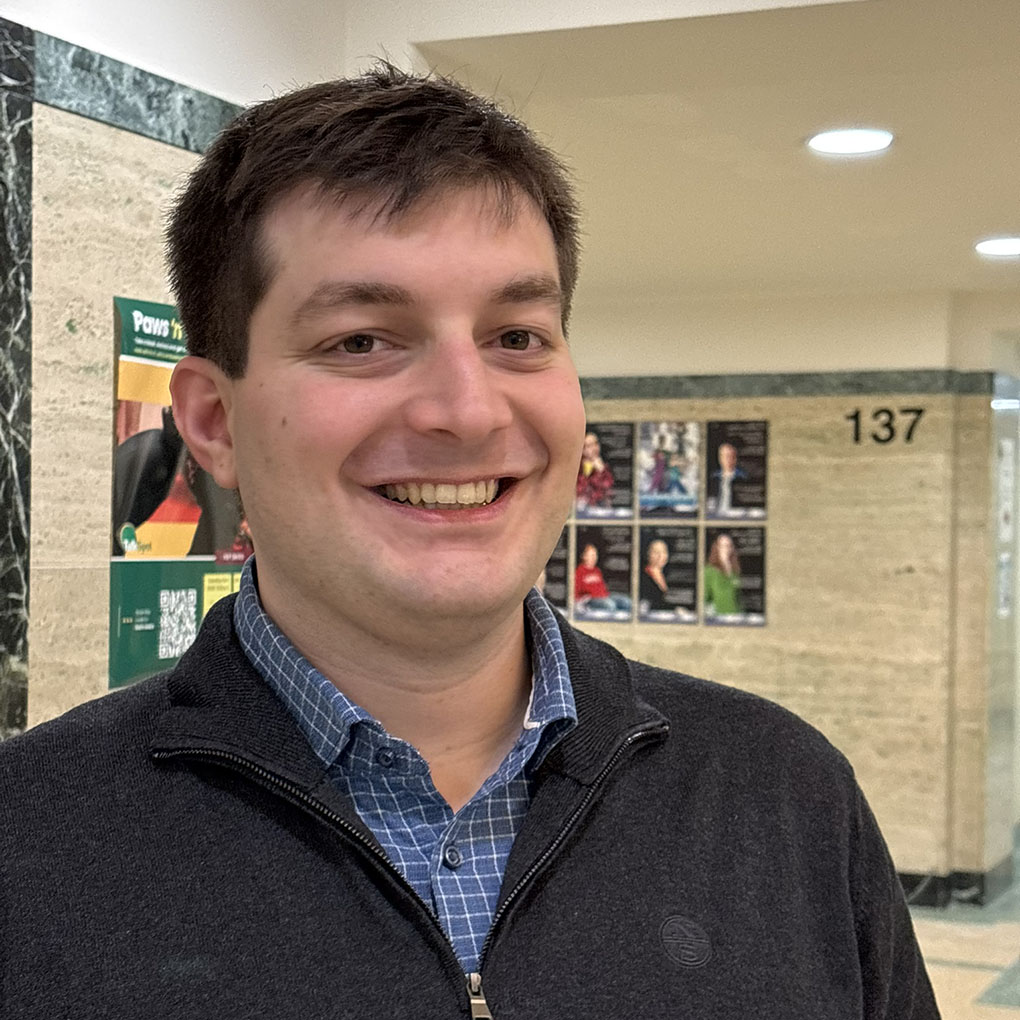
Federico Formica, a McMaster University PhD student with the Centre for Software Certification (McSCert), has earned a major international honour: the ACM SIGSOFT–SIGBED Frank Anger Memorial Award. Recognized for his leadership, cross‑disciplinary insight and rising impact in safety‑critical software engineering, Formica is joining an exclusive group of emerging researchers shaping the future of the field.
For him, the recognition is both affirming and motivating.
“It’s a tremendous honour to be acknowledged by a globally renowned organization,” Formica says. “I am extremely grateful to receive this award since I fully share its mission of strengthening the connection between the software engineering and embedded systems communities.”
Created in memory of Dr. Frank Anger — a visionary advocate for breaking down research silos — the award celebrates students whose work connects and elevates multiple disciplines. Formica will receive the honour at the 48th IEEE/ACM International Conference on Software Engineering (ICSE) in Rio de Janeiro, Brazil, this April.
A research path driven by real‑world impact
Formica’s academic journey began in Italy, where he completed a master’s in mechanical engineering at Politecnico di Milano. A growing interest in cyber‑physical systems (CPS) — technologies that integrate software with physical processes — led him to McSCert to pursue research in model verification and automated testing. These areas align closely with the Centre’s internationally recognized leadership in safety‑critical software certification.
CPS impact everyday life across industries, explains Formica, including autonomous driving features, industrial robots, medical devices, home appliances and more. Because these systems directly affect human safety, Formica emphasizes that rigorous testing, analysis and certification are not optional — they are essential.
It’s a tremendous honour to be acknowledged by a globally renowned organization. I am extremely grateful to receive this award since I fully share its mission of strengthening the connection between the software engineering and embedded systems communities.
Testing such systems is complex. Their behaviour depends on both software logic and continuously varying physical parameters like velocity, torque or pressure. “Exhaustively testing all possible scenarios is impossible,” says Formica.
While many researchers design generalized testing techniques using limited model knowledge, Formica’s work proposes a different approach: harnessing domain‑specific knowledge to guide testing more intelligently and effectively.
To support this idea, he developed two open‑source tools — ATheNA and Hecate — which allow engineers to integrate insights from the model development process, previous testing activity and domain expertise into automated test generation. These tools iteratively generate and execute test cases, assess whether models meet their specifications and highlight critical behaviours and faults.
The result is a more focused verification process — one with direct implications for industries such as automotive, aerospace, medical and nuclear systems, where reliability is critical.
A community that shaped his work
Formica credits McMaster and McSCert with providing the supportive environment that enabled his research to grow.
“The McMaster community has been extremely welcoming during the whole four years of my experience here,” he says. He highlights the Computing and Software department and the McSCert group and its strong industry partnerships as essential parts of his development — helping him connect his work to real‑world challenges and applications.
McScert’s close partnerships with industry and its commitment to real-world impact earned it the 2024 IEEE Computer Society TCSE Distinguished Synergy Award.
He also acknowledges the major role of his supervisors Mark Lawford, Professor of Computing and Software and Claudio Menghi, McMaster University Adjunct Professor and Associate Professor at the University of Bergamo.
“Their continued guidance helped me better define my career goals, engage in cutting‑edge research and grow my skills as a scientist,” says Formica. “I am sure I would have never won this award without their support.”