
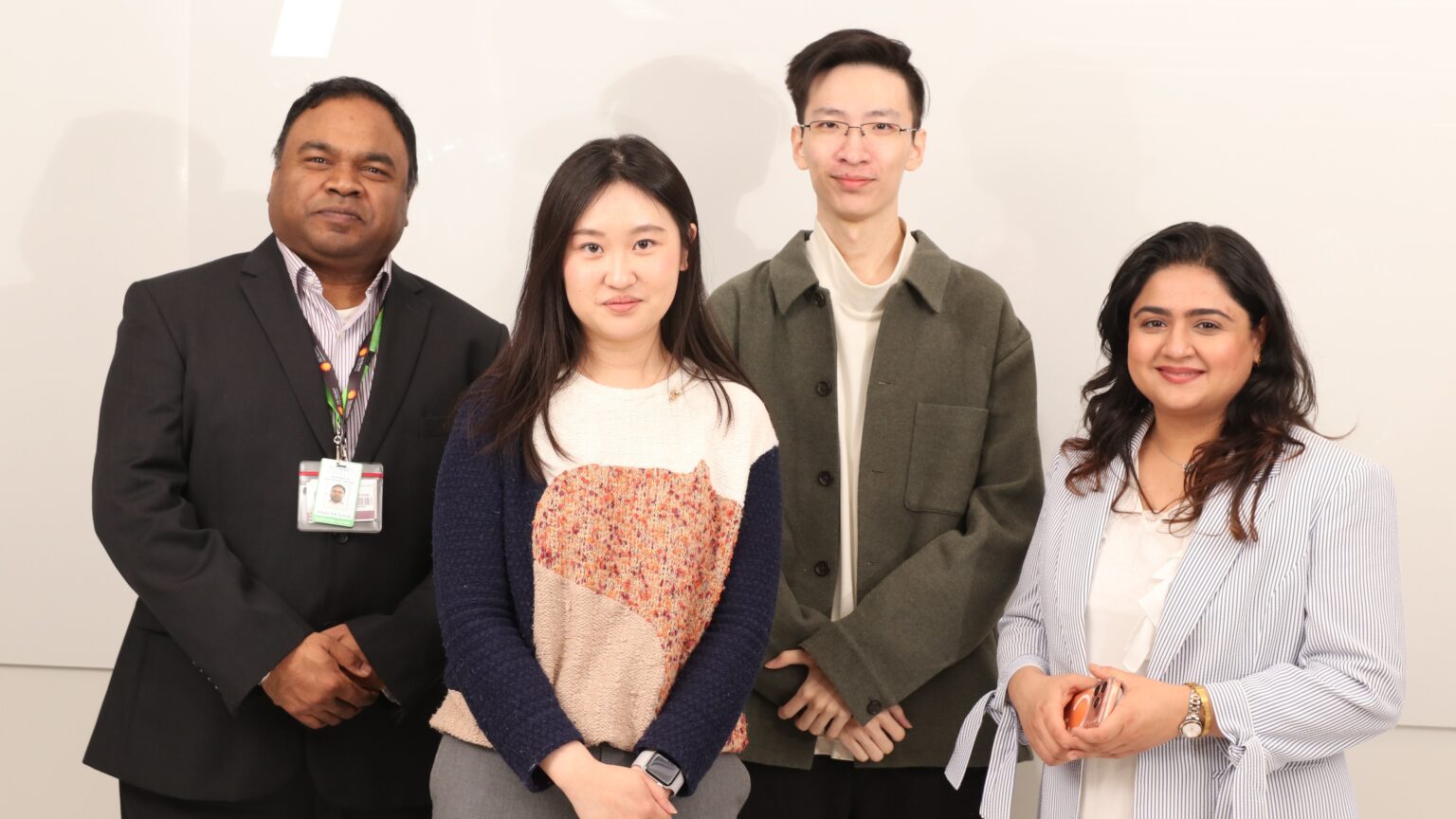
From dialysis care and medical imaging to patient discharge and wait time improvements, McMaster Engineering graduate students are working with St. Joseph’s Healthcare Hamilton teams on practical challenges inside complex healthcare environments.
Those projects were at the centre of this year’s Spring Showcase event held on May 4 which brought together students, faculty, clinicians and administrators to reflect on nearly a decade of collaboration between St. Joseph’s Healthcare Hamilton and the W Booth School of Engineering Practice and Technology, part of the Faculty of Engineering.
Hands-on projects help students build skills inside busy hospital settings
This longstanding relationship began following a joint workshop at McMaster in 2017. Since then, it has created a structure for faculty and students to work alongside hospital staff, patients, families and other stakeholders on real-world challenges and opportunities at the intersection of healthcare and engineering.
To date, the collaboration has supported more than 30 experiential learning projects, giving students enrolled in master’s programs throughout the W Booth School a chance to apply engineering thinking in clinical and operational settings where the stakes are immediate and patient centred.
A variety of projects were featured at the showcase event, including one devoted to incorporating nature inspired biophilic design elements known to help accelerate patient healing into settings at St. Joe’s Hospital. Another aims to build a digital communication platform that will enable care teams to more clearly understand the complex non-medical needs of inpatients returning to the community.
Across the projects, students are supervised by McMaster faculty and supported by healthcare teams and allied professionals at St. Joe’s. The recurrent theme is practical: students learn by working directly with people who understand healthcare delivery, while hospital partners gain fresh engineering perspectives on persistent challenges.
Spring Showcase spotlights learning, growth and impact on patient care
System-wide innovation will be essential as healthcare organizations respond to the needs of an aging population, rising demand and increasingly complex care environments. The St. Joe’s-McMaster collaboration reflects the need for interdisciplinary work by connecting engineering students with healthcare experts who can help them understand the realities of patient care, hospital systems and clinical decision-making.
Professor Robert Fleisig, Program Lead for McMaster’s Master of Engineering Design program, helped create the collaboration and remains a driving force in its development.
“Our goal is to make engineering learners a normal sight at St. Joe’s,” he said. “We’ve come a long way through a relationship built on the mutual goals of education and community service.”

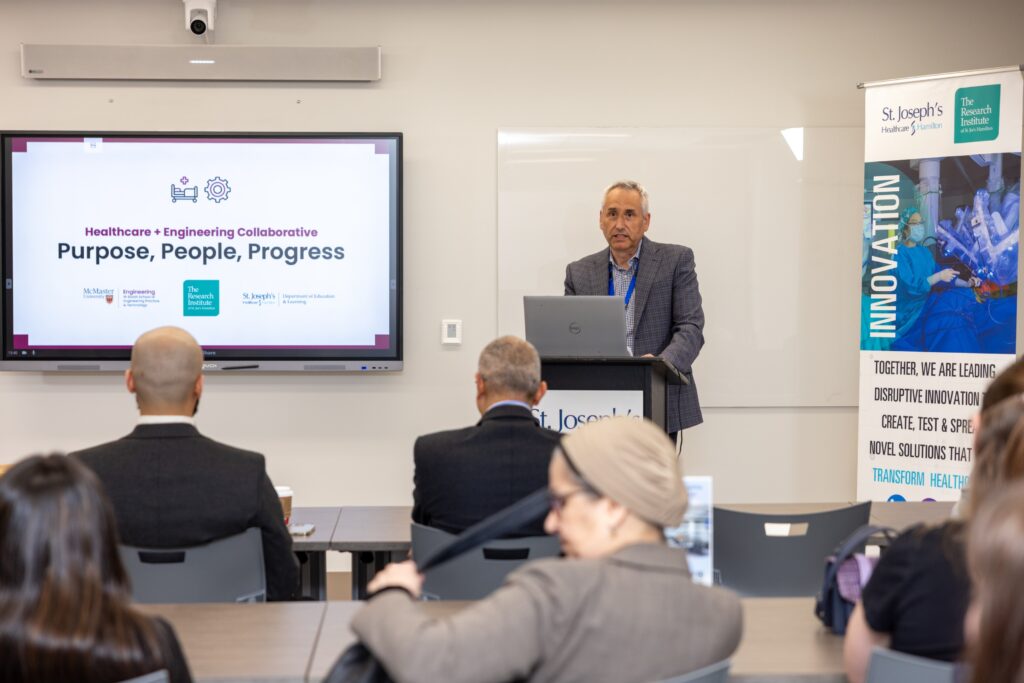
Professor Fleisig opened the showcase event with a talk titled Purpose, People and Progress, where he reflected on the “natural synergies” between St. Joe’s and McMaster in practice-based learning, professional growth and healthcare innovation.
“We should focus on the collective aspects of our work and amplify the impacts,” he said.
The showcase also included a conversation featuring current W Booth School graduate students engaged in projects with St. Joe’s, as well as a panel with McMaster Engineering faculty members, Rashid Abu-Ghazalah, Marjan Alavi and Seshasai Srinivasan.
McMaster faculty, students and staff praised the St. Joe’s community, including administrators, clinicians, staff, patients and families, for providing the access, trust, and practical insights needed to make the collaboration successful.
“All this happens because people show up,” said Fleisig, while acknowledging the “seminal work” of key leaders at St. Joseph’s Healthcare Hamilton, including Rick Badzioch, Dr. Azim Gangji and Sarah Howe.
Partnership looks toward future opportunities
Looking ahead, Fleisig said the partnership is ready to grow and evolve. Future directions could include deeper collaboration beyond a series of projects, such as ongoing scholarship, opportunities for virtual learning, and the potential to commercialize products and services.
In the coming weeks, the collaboration will open a fresh call for proposals, with a focus on expanding opportunities for faculty and student involvement in the 2026–2027 academic year.
Watch Robert Fleisig’s opening talk, “Purpose, People and Progress,” below.