
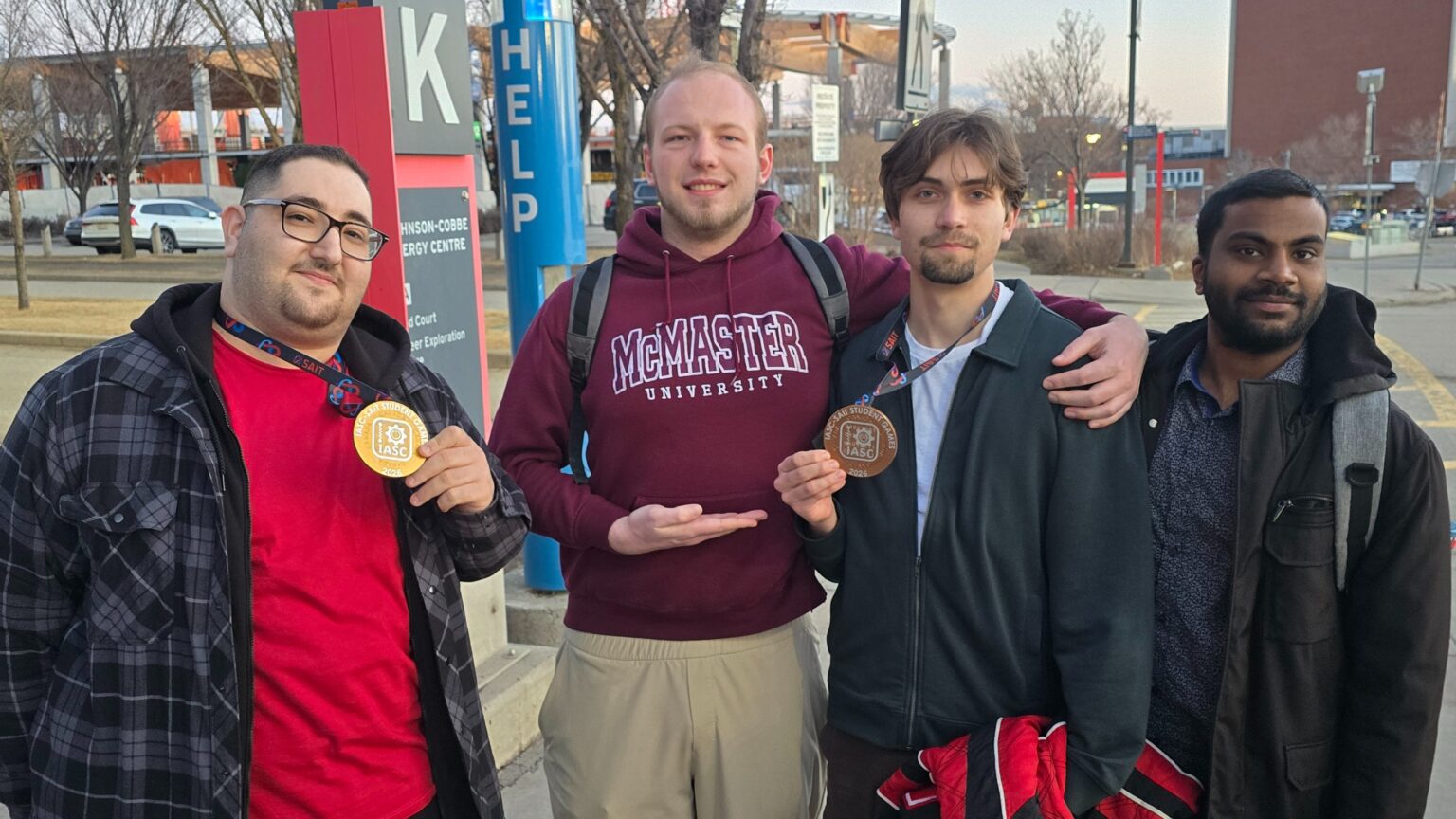
Four students from McMaster University’s W Booth School put their technical expertise and hands-on experience to the test this spring at one of the world’s largest industrial automation competitions.
Automation Systems Engineering Technology students Majd Aburas, Owen Noonan, Maxim Pylypiuk and Wishva Piramenthiratheesan, accompanied by faculty supervisor Ahmed Fakhr, travelled to Calgary to compete in the 12th annual IASC-SAIT International Student Games. Hosted by the Southern Alberta Institute of Technology’s (SAIT) MacPhail School of Energy, the competition brings together automation students from around the world to solve complex, industry-inspired engineering challenges, ranging from process control and industrial communications to PLC programming and more, over the course of four days.
Recognized as the world’s largest student-led industrial automation competition, the games welcomed students from 13 post-secondary institutions across five countries. Rather than competing alongside classmates, however, students are randomly assigned to multidisciplinary teams made up of participants from different institutions and countries, along with one local SAIT student, forcing the students to focus on collaboration as much as technical ability.
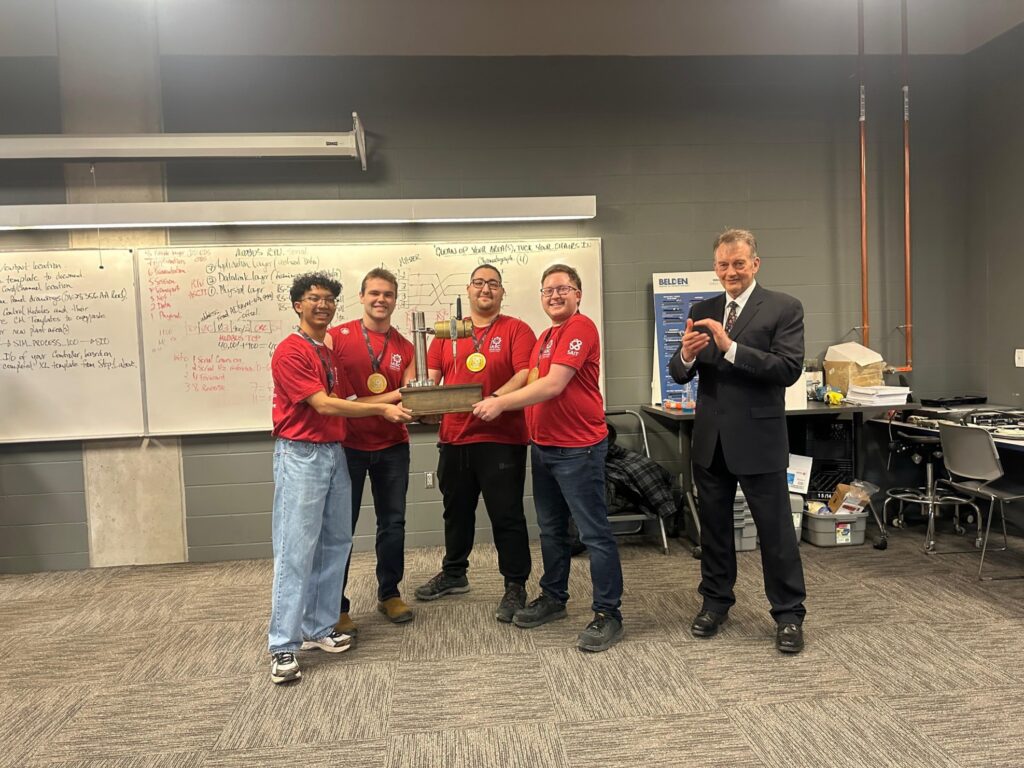
For second-year student Majd Aburas, the competition highlighted the strengths of McMaster’s Bachelor of Technology program.
“Our program is incredibly hands-on and industry focused,” says Aburas. “We gain extensive experience with industry-standard equipment and develop practical skills across multiple engineering disciplines. That foundation gave me the confidence to adapt quickly throughout the competition.”
Aburas was randomly assigned to Team Burgundy, which earned the highest overall score of the competition, securing the Gold Medal alongside students from SAIT, Lambton College and Red River College. The achievement marks the first time a team including a McMaster student has won the competition’s top honour.
“The biggest challenge was the mental agility required to rapidly switch between different disciplines,” says Aburas. “Because we recognized each other’s strengths and knew when to hand off a task, we adapted seamlessly and worked like a well-oiled machine.”
The BTech automation program provides countless opportunities to work in labs, so collaborating in a team to solve technical problems felt very familiar
While only one mixed team claimed the top podium finish, all four McMaster students walked away with valuable experience.
For fourth-year student Wishva Piramenthiratheesan, the hands format of the competition felt second nature. “The automation program provides countless opportunities to work in labs, so collaborating in a team to solve technical problems felt very familiar. With limited time to complete each challenge, communication and teamwork were the skills I relied on most.”
“You might not always have the skills to solve a problem, and that’s okay. It’s important to ask for help from your team.” Said Owen Nooman, demonstrating that ability to lean on others proved just as important as technical knowledge.
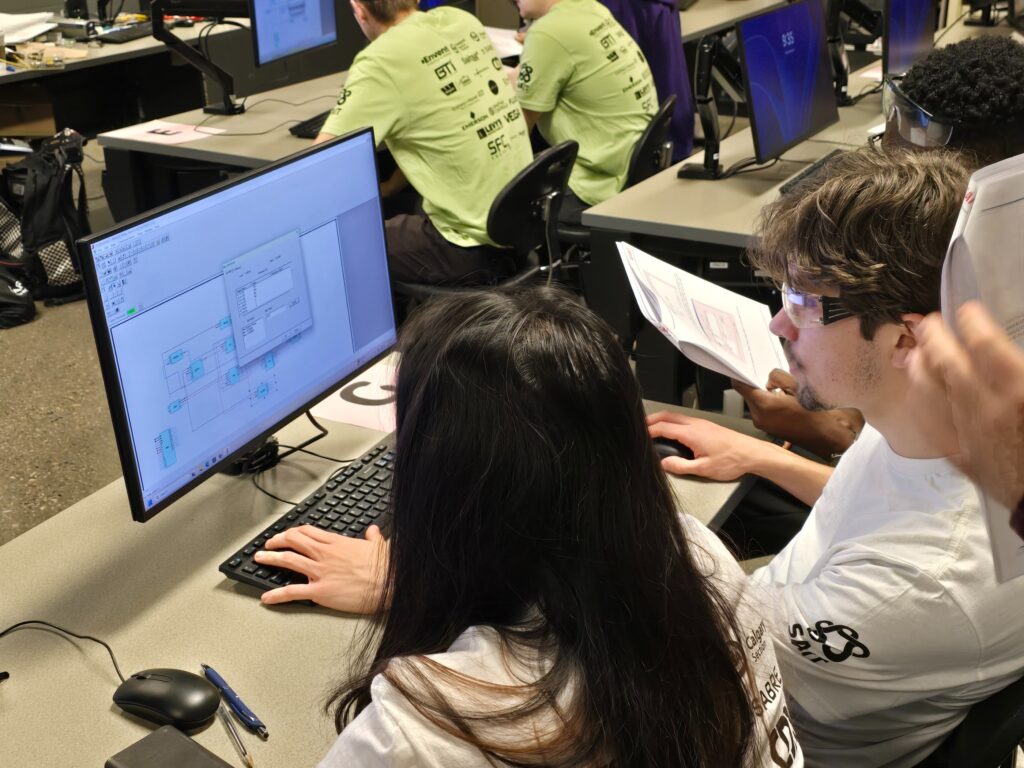
Third-year student Maxim Pylypiuk shared similar thoughts around communication and collaboration. “Our team’s communication transformed us from a lost, clumsy group into an efficient machine where everyone knew exactly what page the others were on.”
Professor Ahmed Fakhr, who accompanied the students at the competition expressed high admiration for their performance: “Seeing our students adapt so quickly, communicate effectively and perform at such a high level is a testament to the hands-on learning experiences they receive in the Bachelor of Technology program.”
For the students, the experience demonstrated that success in engineering relies on more than technical knowledge alone.
“My biggest takeaway is that no matter how skilled you are individually, no single person knows everything,” said Aburas. “Great engineering is fundamentally collaborative.”