
As the world turns its attention to the 2026 Winter Olympic Games in Milan–Cortina, Italy, excitement is building — especially with National Hockey League players returning to Olympic competition for the first time since 2012. But alongside that anticipation has been a growing concern about the quality and safety of the rinks where they’ll compete.
McMaster University Mechanical Engineering Professor Cheryl Quenneville has her sights set on another pressing safety issue for hockey players: the equipment that’s supposed to protect these athletes in the first place.
A blocked shot off the skate, a slash across the arm or a jarring hit into the boards can lead to severe, career-altering injuries. Yet what may surprise fans watching professional athletes with million‑dollar contracts fly across the ice is that much of their gear remains largely unregulated for safety.
Unlike helmets and neck guards, which must meet strict impact and blade‑resistance standards respectively, upper‑body padding and even hockey skates have no equivalent requirements.
It’s a critical gap the McMaster Injury Biomechanics Laboratory is determined to close, one crash test at a time.
Padding problems
For Biomedical Engineering PhD student Morgan Pluim, this work is personal and technical. She grew up on the ice — first in hockey pads, then in ringette gear — a sport she says is known to be “the fastest game on ice.” She knows how it feels to throw your body into a play and trust the equipment you’re wearing to shield you from whatever comes next.
What she didn’t know, until she joined Quenneville’s lab, was how little evidence backs that trust.
“Players bulk up with gear to protect them,” she says, “but there’s so little proof about how well it actually attenuates the force of the hits they’re taking.”
That realization has shaped her research trajectory. Rather than focusing on the head and neck — areas with well‑established standards — she’s turned her attention to the arms and elbows, where slashes, stray pucks and hard collisions happen dozens of times a game.
Elbow pads and the newer forearm guards are meant to act as small, lightweight shields. But because that vulnerable strip between the elbow pad and the glove often takes the brunt of stick contact, Pluim wants to understand just how exposed players truly are.
Players bulk up with gear to protect them, but there’s so little proof about how well it actually attenuates the force of the hits they’re taking.
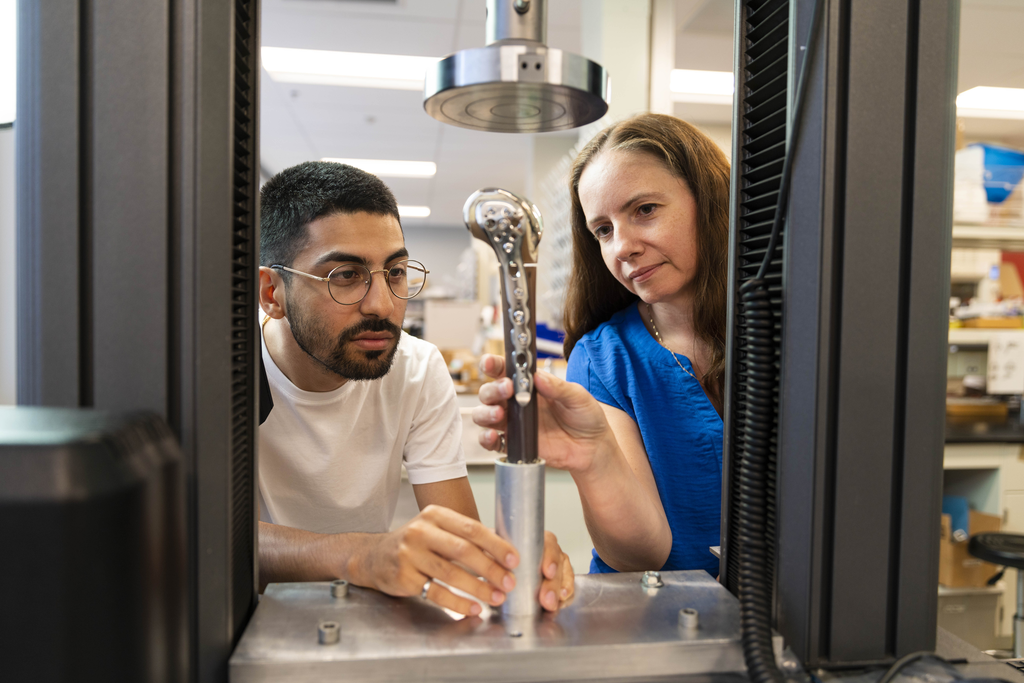
The challenge is that the human body is a complicated thing to replicate — especially when it’s being hit. “To test real protection, researchers need a limb that reacts like a human one,” she explains. “Not just in shape, but in stiffness, in tissue compression, in how force travels through soft tissue and settles in bone.”
So Pluim is building one. Her surrogate arm is part mechanical skeleton, part engineered flesh. Inside, sensors measure force. Outside, she’s experimenting with different silicones and urethanes to create a soft‑tissue layer more realistic than the vinyl‑foam blends used in automotive surrogates.
If she can perfect the surrogate, she can begin testing by striking it at known, repeatable energy levels, measuring the forces with and without equipment and mapping how protection truly performs under what existing literature says are typical speeds and force of a puck, stick or body.
The smasher
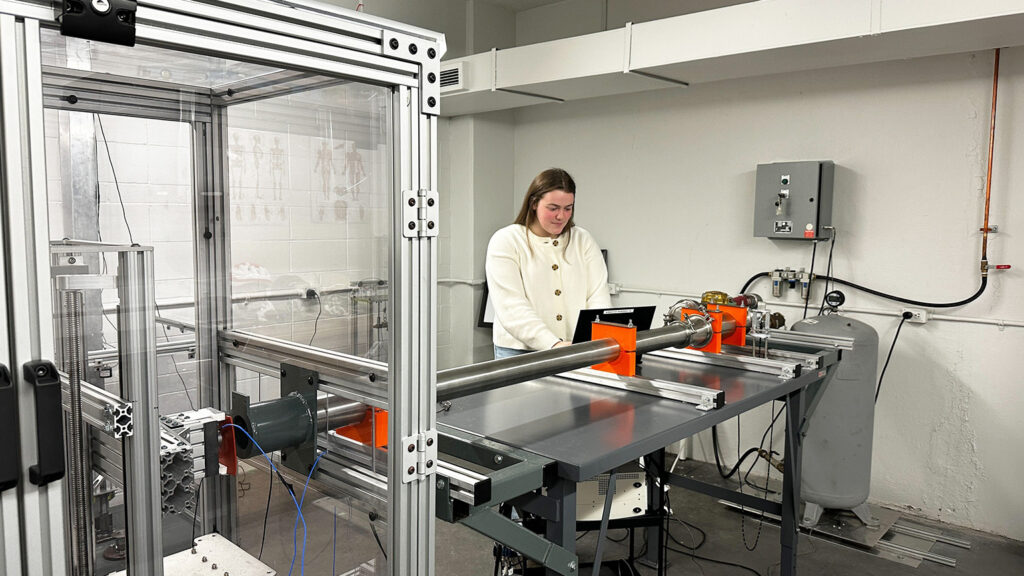
Testing in the McMaster Injury Biomechanics Lab involves a device that’s earned a name equal parts intimidating and affectionate: the smasher.
It looks like a piece of industrial equipment — a steel tube fed by a compressed‑air tank. But to the researchers who use it, it’s a precise and trusted instrument. It delivers the same hit, the same way, every time.
“Using the weight of the impactor and the air pressure, we’re able to mimic certain energy levels, whether that’s a puck traveling at a high speed or the concentrated loading of a slash,” Quenneville explains.
The smasher is hooked up to a laptop, where results are fed. It has become the great equalizer in the McMaster team’s research: impartial, consistent and willing to hit as hard as needed to expose vulnerabilities in equipment design.
Shots to the skate
Pluim’s work is building on years of equipment testing by lab mates past and present, which has helped form a shared foundation of knowledge to advance new projects.
One of those former lab mates is Emelyn Kupinski, a recent Master of Mechanical Engineering grad, whose work addressed a vulnerability to the foot and ankle with hockey skates in collaboration with Warrior Sports – a hockey and lacrosse equipment manufacturer in Montreal.
Hockey skates used by professional players are typically ultra‑light, stiff and designed for explosive acceleration and razor‑sharp direction changes. But for all their performance, they’re not designed with mandatory safety standards in mind. And puck strikes to the skate are among the leading causes of fractures and deep contusions in the sport, says Quenneville.
Kupinski developed a fully instrumented foot and ankle surrogate designed specifically for hockey‑impact research. Built around a 3D‑printed hard‑tissue core and wrapped in a removable urethane “soft tissue,” the surrogate contains six embedded sensors positioned over clinically identified high‑risk areas.
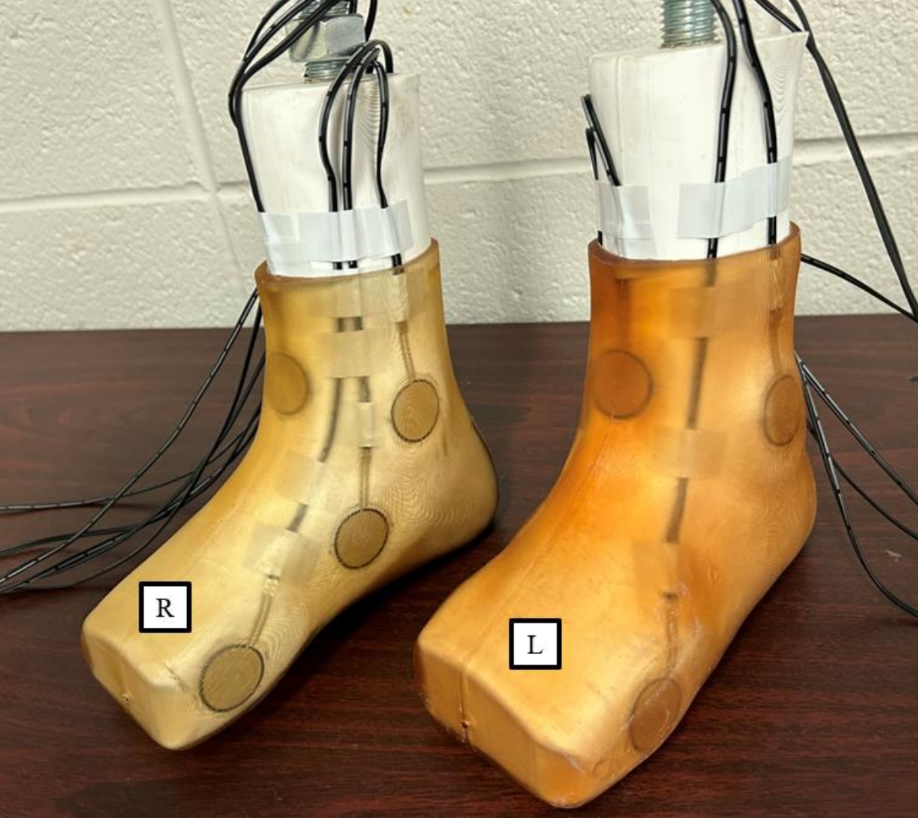
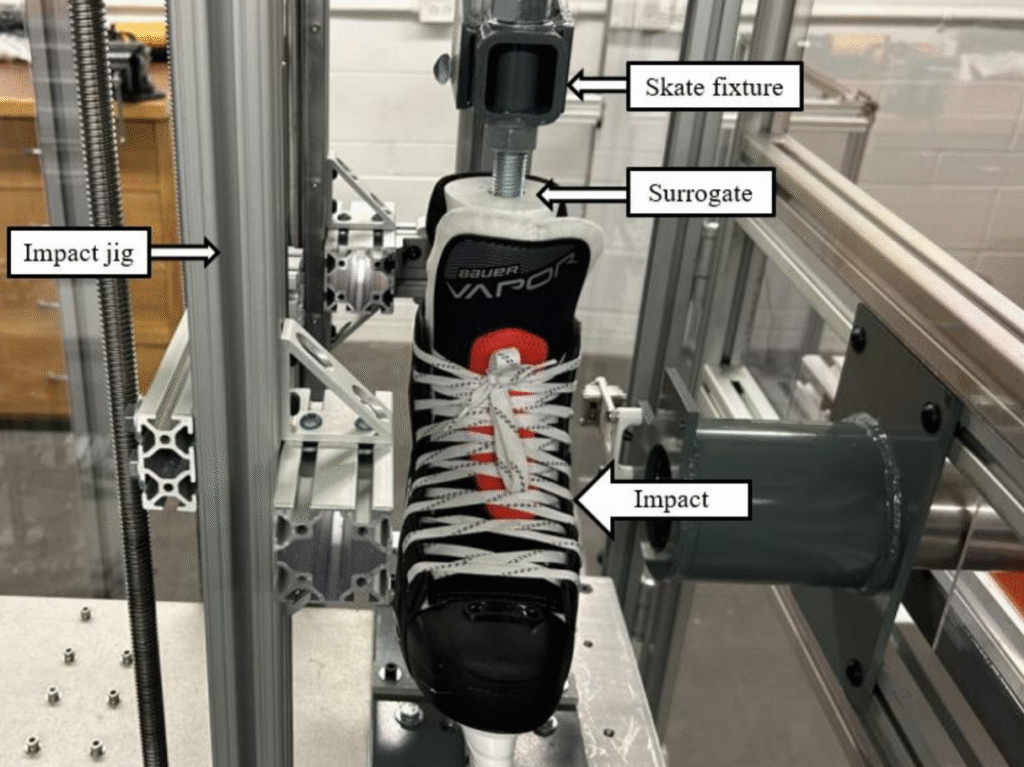
She tested three elite commercial skate models against the energy of an 80 km/h puck, with impacts to six locations across the boot and tongue, two areas known to take puck impacts. Each strike revealed how much force the skate reduced before it reached bone‑equivalent tissue.
The results told a clear story – certain skates were better than others at providing protection, but this varied with the shot location. Perhaps most surprising to the team was that the model offering the greatest protection wasn’t the heaviest or the most expensive.
Kupinski’s surrogate proved highly repeatable and helped validate what players, coaches and equipment manufacturers have long needed: objective evidence that skate construction materially changes safety.
Quenneville says she didn’t begin this foray into hockey equipment testing because of a passion for the sport — she saw an opportunity to improve safety that no one else was answering and jumped on it.
Now, with her McMaster Injury Biomechanics Lab team, every surrogate built, every impact measured and every dataset analyzed is assembling the evidence needed to move the sport forward, safely.