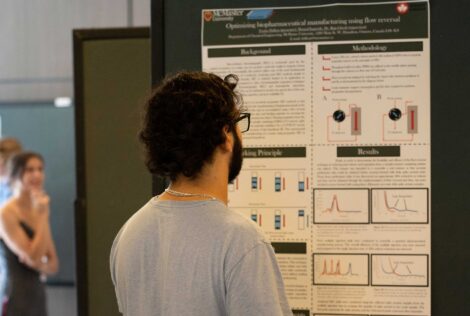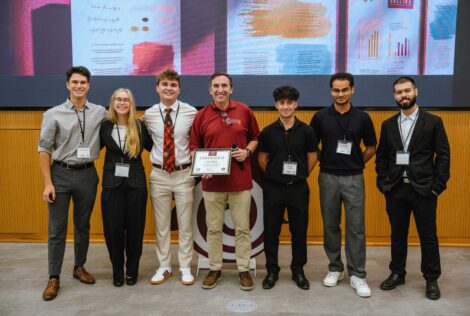
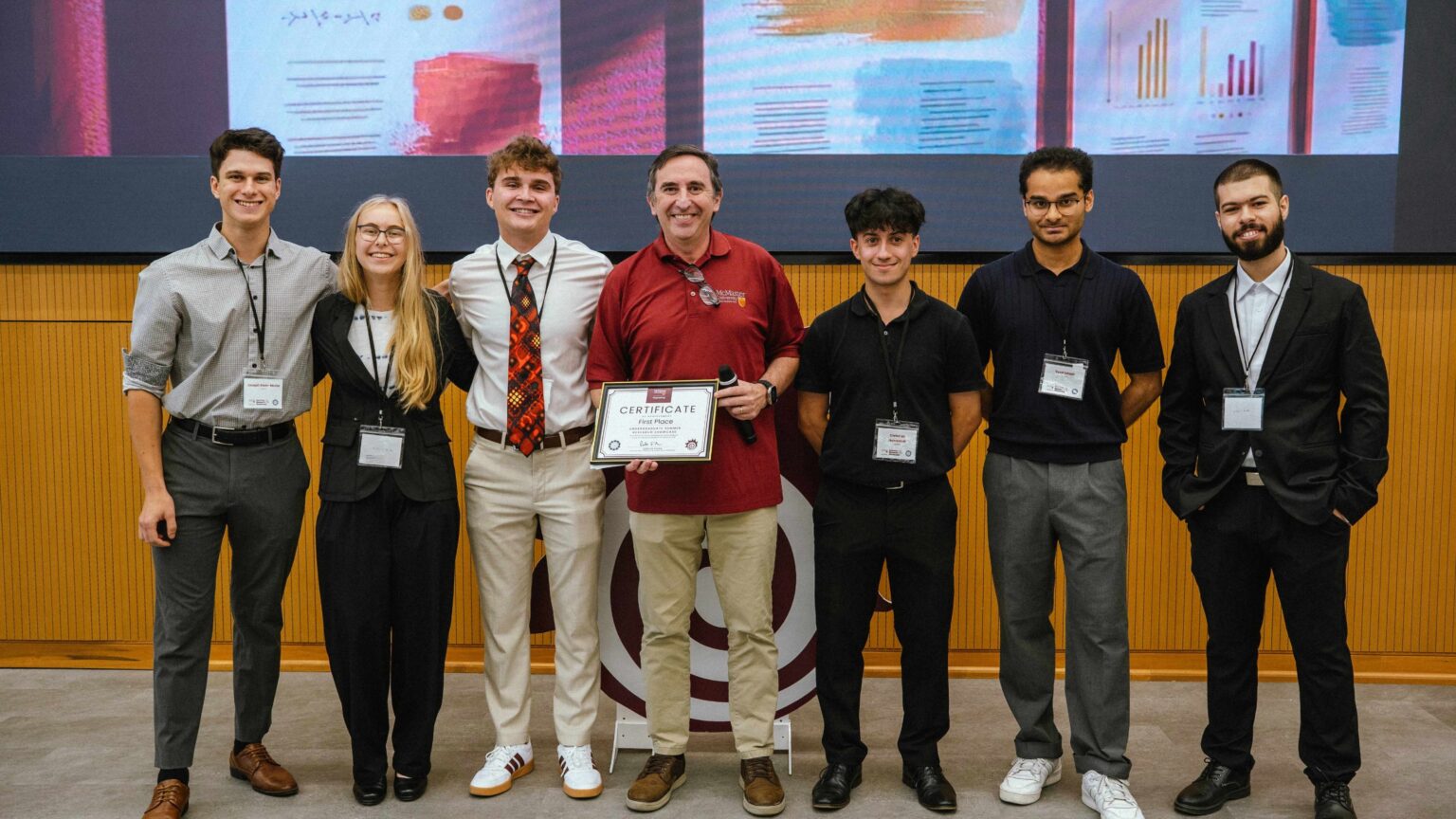
This past summer, McMaster students had the opportunity to get their hands dirty and learn how the world of research works.
From time spent in the lab to hands-on learning, the students who took part in summer research programming spent their summers building their skills, learning from faculty and graduate mentors and exploring the real-world impact research can have. They also had the opportunity to learn the importance of science communications when they presented their work at the 3-Minute Thesis competition and annual Summer Research Poster Showcase.
We caught up with seven students that took part in these presentations to understand their research, reflect on their experiences working in a variety of labs, and offer advice to students who may be interested in pursuing summer research.
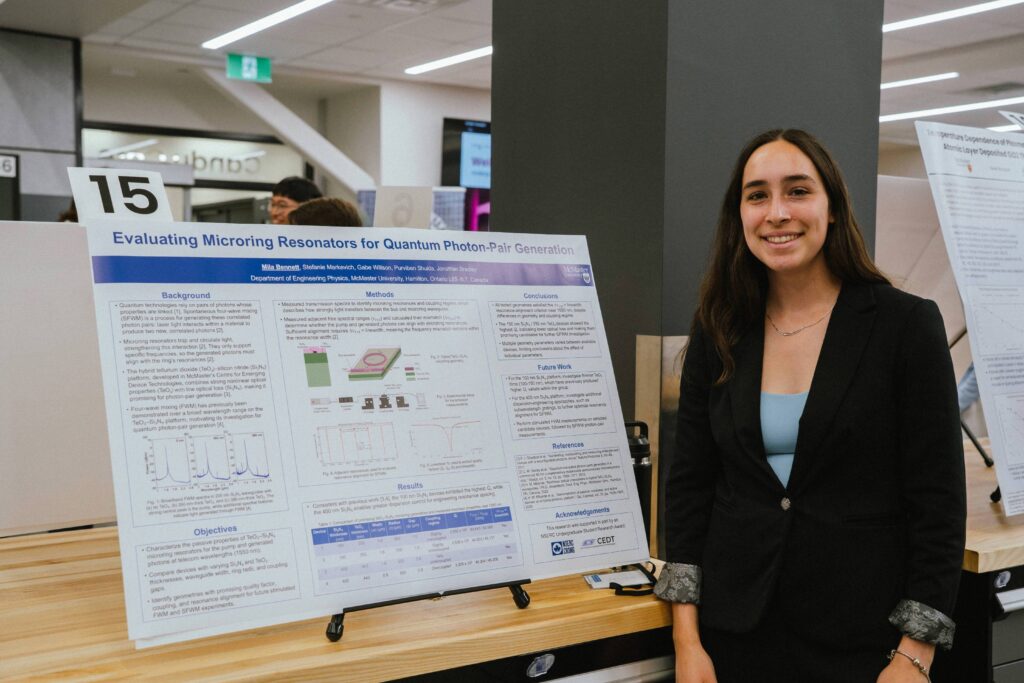
Mila Bennett, Engineering Physics and Biomedical Engineering, Level III
“Evaluating Microring Resonators for Future Photon-Pair Generation”
Supervisor: Jonathan Bradley, Director, Centre for Emerging Device Technologies
Can you explain your research project?
My research focused on photonics — the science and technology of using light. I evaluated tiny, ring-shaped devices called microring resonators for their potential to generate photon pairs on a chip. These photon pairs could support future advances in quantum computing and communication.
What was your favourite part about doing summer research?
My favourite part was learning from the Master’s students I worked with as I explored a field that was new to me. I loved being able to ask questions, learn from their experience and challenge myself to understand unfamiliar concepts.
What made the summer research experience valuable to you?
The experience reinforced how much I love learning and helped me discover that I thrive in an environment that encourages curiosity, exploration and hands-on work. I especially enjoyed moving between practical work and the theory behind it, using each to deepen my understanding of the other.
What advice do you have for students thinking about doing summer research?
Pursue opportunities that spark your curiosity, even if you’re not sure they’ll lead to a career. Don’t shy away from a field because it feels challenging, abstract or unfamiliar. Exploring something outside your comfort zone can teach you a lot, both about the subject and about what you enjoy.
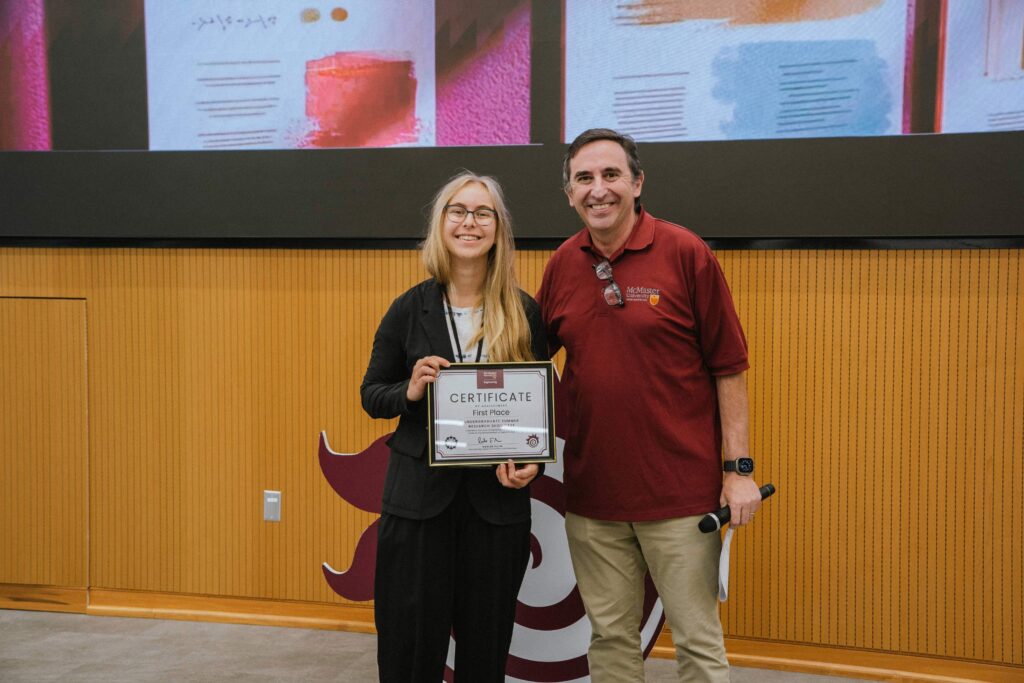
Elenna Gellatly, Engineering Physics and Biomedical Engineering, Level II
“An Analysis of SEI-forming Electrolyte Additives through Density Functional Theorem”
Supervisor: Keren Jiang, CanmetMATERIALS – Natural Resources Canada
Can you explain your research project?
My research focused on batteries. Can we use simulation to better understand electrolyte additives and inform future design? My project used density functional theorem (DFT) to study solid electrolyte interphase (SEI) forming electrolyte additives and how molecular structure influences interphase stability.
What was your favourite part about doing summer research?
My favourite part of this summer was meeting and speaking with specialists. I left every conversation with something new to think about and a broader perspective that helped me situate my own research. In terms of highlights, using high-temperature furnaces was definitely one of them!
What made the summer research experience valuable to you?
The research environment is valuable because it provides dedicated time to learn new things and push yourself. I also benefited greatly from the mentorship of all my colleagues.
What advice do you have for students thinking about doing summer research?
I’d encourage students to pursue summer research. It challenged me in new ways that strengthened the analytical and problem-solving skills developed through coursework.
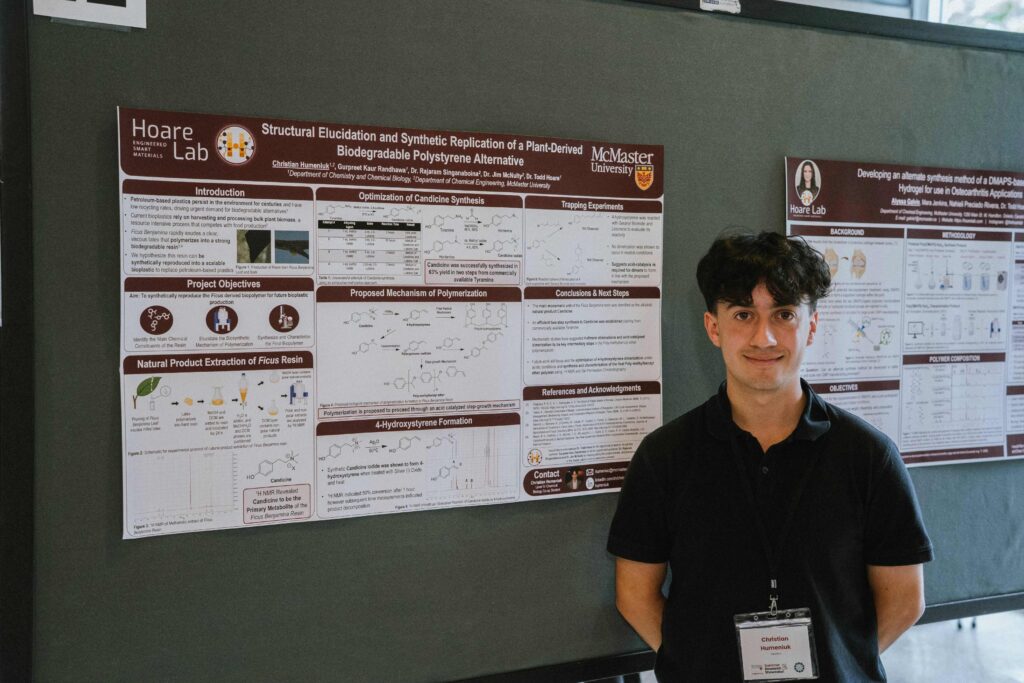
Christian Humeniuk, Chemical Biology, Level IV
“Structural Elucidation and Synthetic Replication of a Plant-Derived Biodegradable Poly Styrene Alternative”
Supervisor: Todd Hoare, Professor, Chemical Engineering
Can you explain your research project?
The overproduction of single-use plastics has taken a serious toll on the environment. Biodegradable plastics offer an alternative, but producing them often requires resource-intensive, large-scale harvesting and processing of plant material. Our project focused on taking a plastic-like resin from the Ficus plant and exploring how to synthetically reproduce it in the lab, enabling large-scale bioplastic production without needing to harvest the plant itself.
What was your favourite part about doing summer research?
My favourite part of my summer research experience has to be all the relationships and connections I’ve built with the people in my lab. The Hoare lab has such a unique and supportive lab culture, and I am truly grateful for having the opportunity to work there. The lab has such a range of diverse personal, academic and research experiences, so everyone is able to offer a fresh and unique perspective when it comes to research. When it comes to my favourite experiences, of course I have to shout out all the fellow undergrads who have truly made this summer one of a kind. Whether it was all the Tim’s runs, the Cambio games at lunch, or the Phoenix trivia Tuesdays, getting to spend this summer research experience with you all has made it so much better.
What made the summer research experience valuable to you?
Coming from a science background and having previously worked in a science lab beforehand, there was certainly a lot I had to learn about chemical engineering and how engineering research works. This exposed me to so many new research topics, instruments and techniques that I would not have known about otherwise. I am very grateful to have been encouraged to present my research. I would have never signed up to give these presentations on my own, but I truly think it was such an important part of my summer experience. Science communication is such an essential skill to have, and being able to present my research in both a non-technical and technical way is something that I will hopefully carry on throughout my career.
What advice do you have for students thinking about doing summer research?
Don’t be afraid to reach out to professors outside of your department or faculty. Science is becoming increasingly interdisciplinary, and you would be surprised how diverse the research areas of some labs are. As a student in chemical biology, I probably wouldn’t have believed you if you had told me two years ago that I would be working in a chemical engineering lab, but now I can confidently say that chemical engineering is a field I’d be interested in pursuing further.
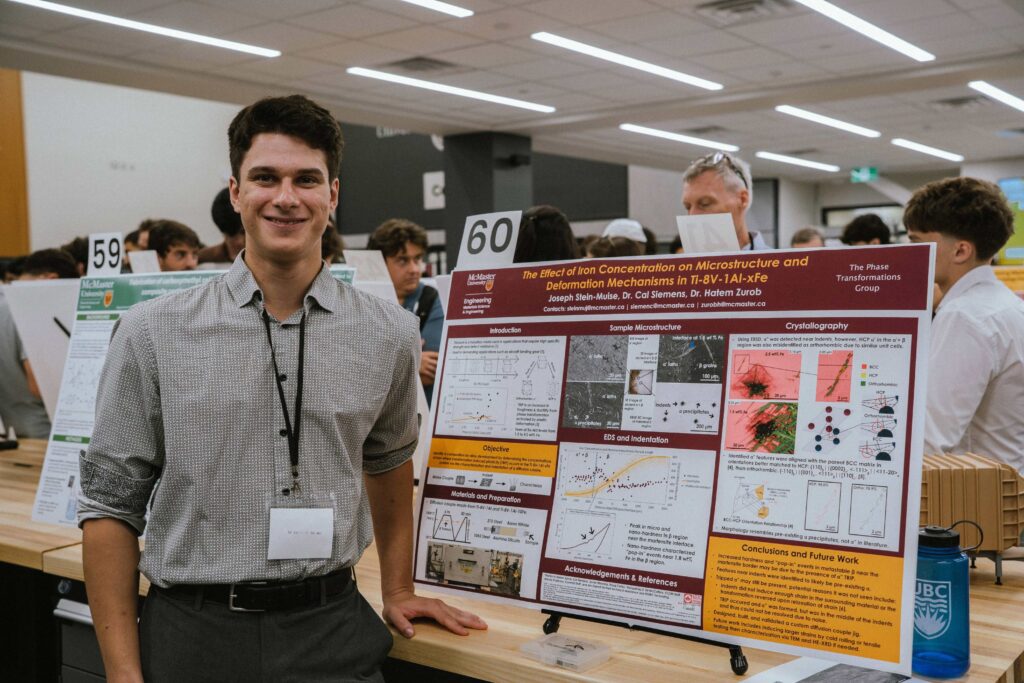
Joseph Stein-Muise, Materials Science and Engineering, Level IV
“The Effect of Iron Concentration on Microstructure and Deformation Mechanisms in Ti-8V-1Al-xFE”
Supervisor: Hatem Zurob, Professor, Materials Science and Engineering
Can you explain your research project?
My project was using titanium diffusion couples to investigate how a range of titanium alloy compositions react when they are deformed. Specifically, in what range of iron compositions do we see deformation twins or stress-induced-martensite (TRIP).
What was your favourite part about doing summer research?
My favourite part of my summer research was when we did EBSD — a characterization method that shows you the phase and orientation of your material — on a sample which I had cold-rolled and found both the TRIP and twins which we were looking for. It happened right at the end of my co-op term and was the culmination of all my work over the summer term. We had already done it on a different sample which we thought may have had some martensite but ultimately did not, so to see some pixels of blue start appearing on the screen and then finally confirming that what we were seeing was TRIP was really special.
What made the summer research experience valuable to you?
I was given the freedom to explore what I found interesting about my project and empowered to try things on my own. Working through problems and overcoming challenges independently allowed me to learn so much about all aspects of my project. Working with people in the Phase Transformation Group was also extremely valuable. Seeing how they approached their work and how knowledgeable they were on their topics set a standard for me to aspire to if I decide to continue in graduate studies in the coming years.
What advice do you have for students thinking about doing summer research?
If you can find a project you are passionate about, where you can step outside your comfort zone and try new things, definitely go for it. There are a ton of people willing to help you learn and try new things. When trying to land a research position, I would recommend reaching out to professors early in the year so that you can apply for an NSERC USRA research award which helps fund your research term. It’s also a great way to get practical skills — even if you don’t plan on going into research, you will learn things which will be relevant for a career in industry. For me, this came in the way of learning new metallographic preparation methods, performing mechanical testing and getting trained on the SEMs at the CCEM.
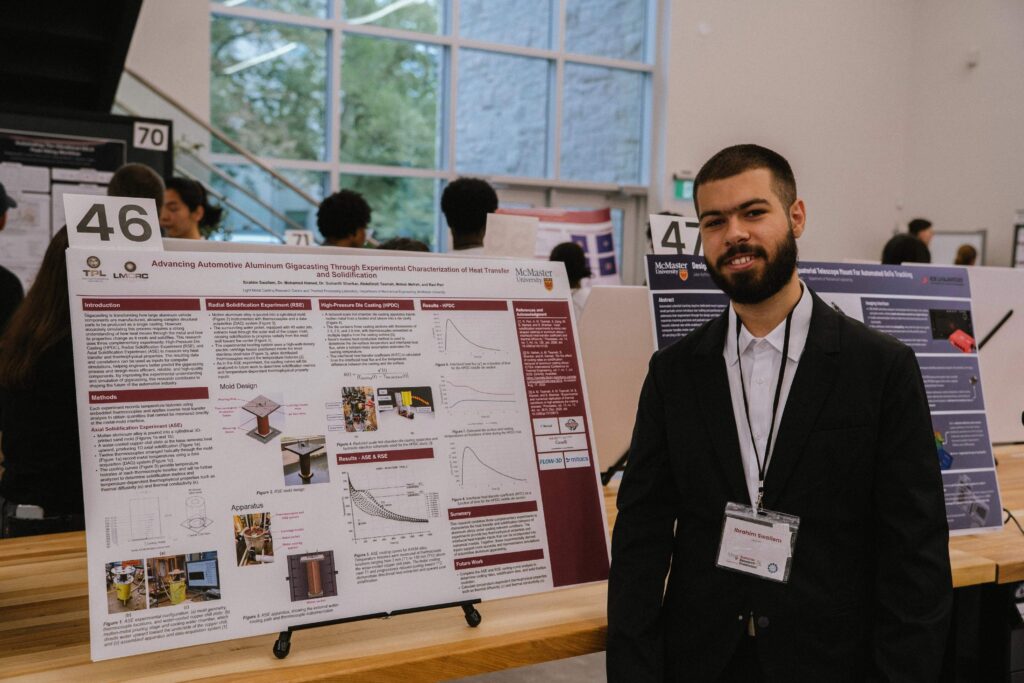
Ibrahim Swailem, Mechanical Engineering and Biomedical Engineering, Level IV
“Advancing Automotive Aluminum Gigacasting Through Experimental Characterization of Heat Transfer and Solidification”
Supervisors: Mohamed Hamed and Sumanth Shankar
Can you explain your research project?
Gigacasting is transforming how large aluminum vehicle components are manufactured by allowing complex structural parts to be produced as a single casting. My research used three complementary casting experiments to study how heat moves through aluminum as it cools and solidifies, producing data that can help engineers improve computer simulations and design more efficient, reliable and high-quality components. By improving our experimental understanding and simulation of gigacasting, this research contributes to shaping the future of the automotive industry.
What was your favourite part about doing summer research?
My favourite part was seeing the entire engineering process come together. I was able to design an experimental mold in SolidWorks, help machine and assemble its components, conduct casting experiments and then analyze the resulting temperature data. One of my most memorable moments was seeing the first cooling curves appear after a successful experiment because they represented months of hard work. I also really enjoyed supporting high-pressure die-casting trials at CanmetMATERIALS – Natural Resources Canada (NRCan) and learning from researchers in an industrial-scale facility.
What made the summer research experience valuable to you?
The experience allowed me to apply concepts from the classroom to a real engineering problem while developing skills in CAD, machining, experimental testing, data acquisition and analysis. It also taught me how to work through uncertainty, troubleshoot problems and take greater ownership of a technical project. Most importantly, I learned from knowledgeable researchers who were always willing to offer guidance while encouraging me to think independently.
What advice do you have for students thinking about doing summer research?
Summer research is one of the best ways to continue learning while gaining hands-on experience in a subject that genuinely interests you. Don’t be afraid to contact a professor whose course you enjoyed and ask about opportunities to explore the subject further. Summer research is also a great way to get a taste of what graduate school is like and decide whether it is something you may be interested in pursuing after graduation.
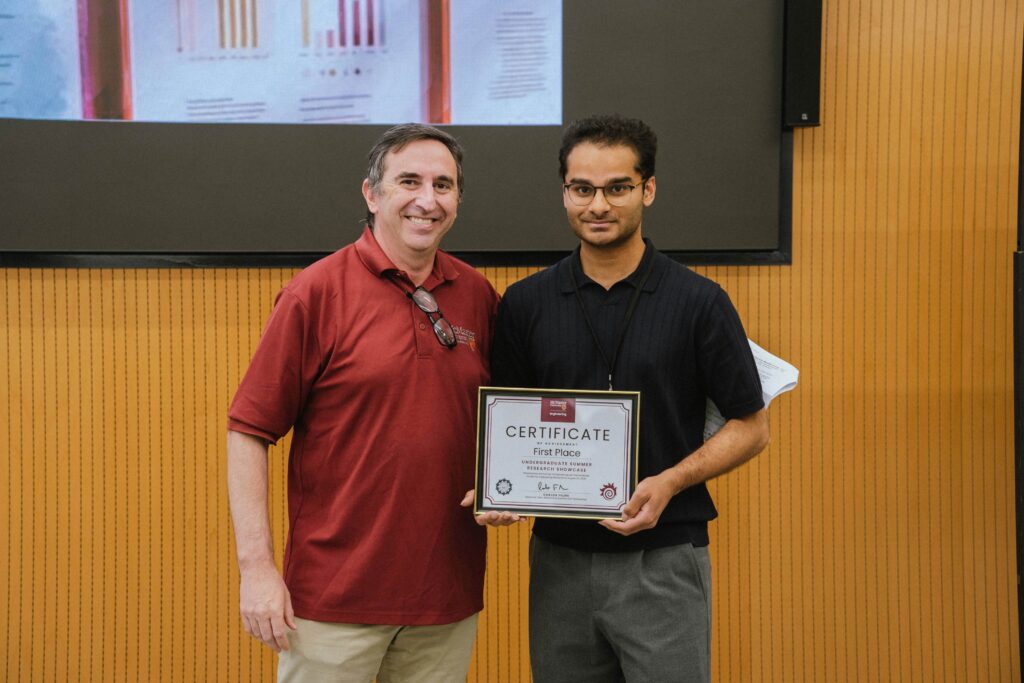
Syed Umair, Honours Biochemistry, Level IV
“Localized pH-Controlled Ibuprofen Delivery with Silica Nanoparticles for Wound Healing”
Supervisor: Todd Hoare, Professor, Chemical Engineering
Can you explain your research project?
Chronic wounds can be immensely painful and are often treated with ibuprofen as an oral pill. The problem with oral administration is that it can cause unwanted side effects due to systemic drug distribution. Our project is seeking to design silica nanoparticles that can carry and localize the delivery of ibuprofen with high efficiency to reduce drug waste and thus reduce side effects.
What was your favourite part about doing summer research?
My favourite experience was actually during the part of the project where things weren’t working. We ran into multiple issues trying to quantify and interpret our data, and I spent weeks trying to troubleshoot. While it was a struggle, I knew it was a normal part of research, and it was interesting trying to solve a problem in real time rather than depending on my supervisor and following instructions.
What made the summer research experience valuable to you?
My lab mates made the experience so valuable. We have a pretty big lab, and I got to spend time with many fellow undergrads outside the lab, like playing cards on break, going out for lunch, and playing trivia at the Phoenix.
What advice do you have for students thinking about doing summer research?
Learn to think like a scientist. Much of that means being able to articulate a scientific hypothesis and interpret new data in a precise manner. Additionally, become familiar with research etiquette, like knowing how to email a professor and communicating your interests and experiences in a concise and relevant manner.
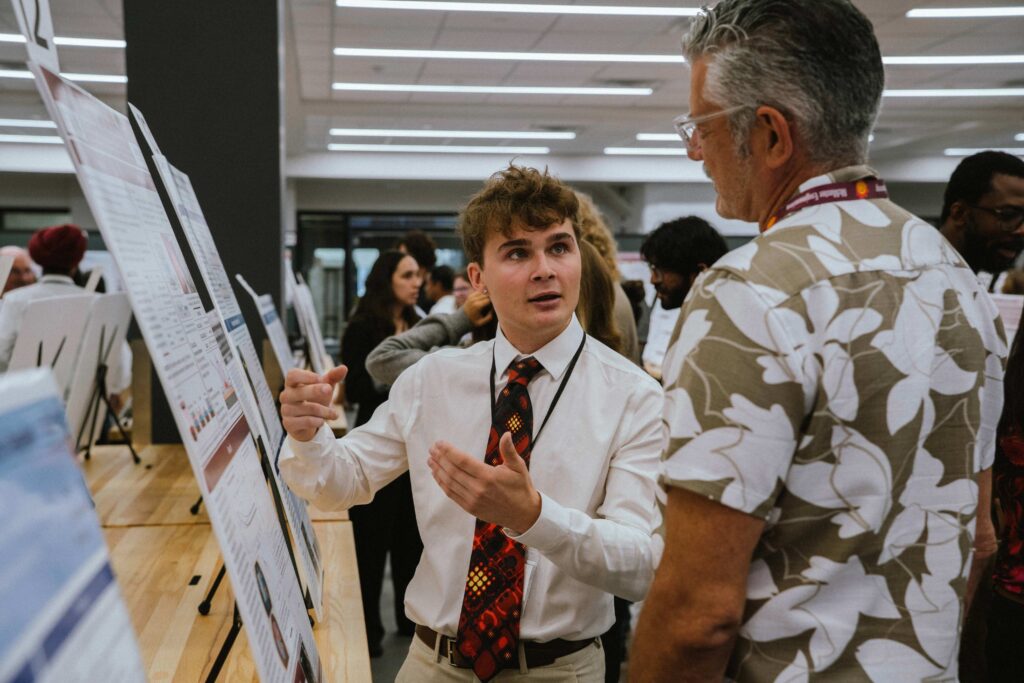
Carter Yott, Engineering Physics and Biomedical Engineering, Level III
“RF Magnetron Sputtering of Silicon Nitride Thin Films”
Supervisor: Jonathan Bradley, Director, Centre for Emerging Device Technologies
Can you explain your research project?
Photonics are widely used in the communications industry in applications such as fibre optic cables. My project dealt with developing and testing the optical properties of silicon nitride thin films for their use as waveguides on photonic-integrated circuits. This material is well researched but reactive sputtering is a promising method of deposition that avoids many of the undesirable effects that come with the present methods.
What was your favourite part about doing summer research?
My favourite part of the project was the freedom and trust I was given to hypothesize, conduct research and derive conclusions on my own. Though I had ample resources in place, I found it rewarding that my work was not prescribed or monotonous. My most memorable experience was getting to work with advanced technology — often large or expensive pieces of equipment that I had not seen before, such as the Lesker sputter system in our cleanroom.
What made the summer research experience valuable to you?
The project was an incredible opportunity to experience the full research process, from learning to doing. It allowed me to explore some topics that I had not yet encountered in my classes. What made the summer most valuable to me was getting to see and talk to my coworkers every day. The CEDT was such a supportive and welcoming place to work, and I am extremely grateful for the friends I made there.
What advice do you have for students thinking about doing summer research?
You likely need 12-16 months of co-op to graduate. This requirement gives you the opportunity to gain experience in multiple fields. Research, therefore, is a worthwhile pursuit. It’s a great chance to dive deep into a specific topic that you may not learn about otherwise, and gain access to the incredible resources McMaster can offer.