Curling has taken its place in the global spotlight at the Milano‑Cortina Olympics, winning over new fans and sweeping up fresh debate after a recent moment of on‑ice controversy went viral. Whether people are tuning in out of national pride, fascination or confusion about why the stones behave the way they do, it’s clear that there’s more science behind the sport than meets the eye.
We reached out to Joseph McDermid, Professor of Materials Science and Engineering, Director of the McMaster Steel Research Centre and long‑time curler. Drawing on both his research background and on‑ice experience, he offered an expert look at the engineering and materials that make curling stones both durable and uniquely capable of their signature glide and curl.
Q: Can you describe your curling experience?
I’ve been curling since around 1993, starting in Montreal and then continuing in Hamilton from about 2017 onward. I play in the recreational leagues at Dundas Valley Golf and Curling Club. I’d definitely call myself a social curler rather than a competitive one.
Q: What materials are used to make a curling rock?
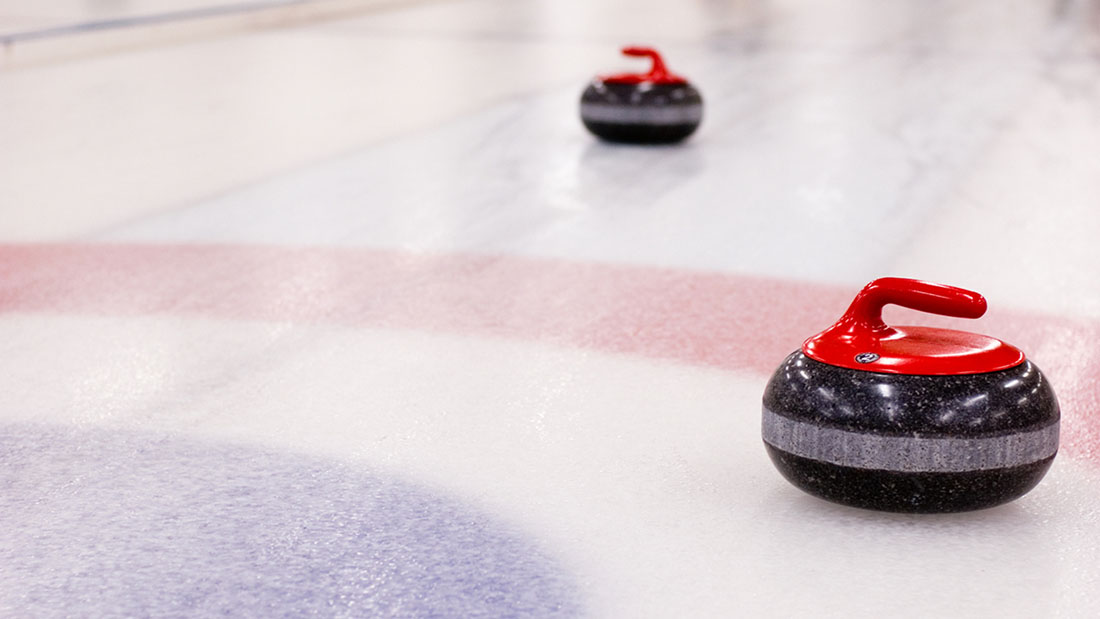
All curling rocks are made from high-quality (meaning low-flaw population) granite. There are several reasons for this – the best quality granites are quite strong and do not absorb water. Since you are sliding on ice, this is very important!
Q: How are curling rocks made?
Top‑tier curling rocks, including those used in professional play and the Olympics, are made from specific granite sourced from Ailsa Craig in Scotland. This granite is prized for its hardness and extremely low water absorption. Many recreational stones come from granite quarried in Wales.
The granite is quarried, checked for any flaws and the curling rock is then precision ground and polished to its final shape. The final steps are the attachment of the handle to rock and a final dressing of the running surface: the thin band on the bottom of the curling rock in contact with the ice. Also, high-quality curling rocks are frequently made in matched sets and extensive testing is required to produce matched sets. Overall, this is a very expensive and time-consuming process.
Q: Why are curling rocks so expensive?
Factors include the scarce source of suitable granite – not just any granite will do – and the very expensive and high precision processing required to produce a high-quality curling rock. High quality curling rocks will typically come in at $15K – $20K for a matched set of 16 stones. Fortunately, high quality curling rocks have a lifetime measured in decades.
Q: How does the ice interact with the stone?
This is a subject of much debate and, to be honest, I don’t think anyone really knows the answer to that question. But one of the critical elements is that curling ice is “pebbled” or has small bumps put on it by the ice-maker spraying small water droplets onto the surface. For example, trying to throw a curling rock on a hockey surface would bring the rock to a halt very quickly!
Q: What are your thoughts on “push‑gate”? Does an extra index‑finger push before the hogline really matter?
Double‑touching is certainly against the rules. At the Olympic level, that extra push might have a measurable impact, but at the amateur level it usually ends poorly. I haven’t reviewed the videos from the men’s incident or the penalty issued to the Homan rink, but ultimately these decisions should be assessed by the umpires — not by public opinion.