Expertise
Areas of Specialization


Research Clusters




Current status
-
Accepting graduate students
-
Associate Professor
Materials Science and Engineering
Overview
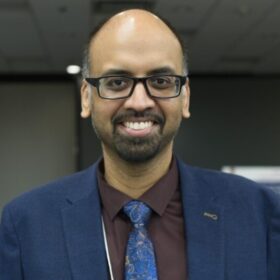
Dr. Suraj Persaud is the University Network of Excellence in Nuclear Engineering (UNENE) Research Chair in Corrosion Control and Materials Performance, leading a nationally recognized research program focused on corrosion and structural materials in nuclear energy systems. His research combines corrosion science, electrochemistry, materials engineering, mechanics, and advanced characterization to improve the safety, reliability, and long-term performance of materials used in current and next-generation nuclear reactors. The Persaud Corrosion Group conducts collaborative research with Canada’s nuclear utilities, national laboratories, government agencies, regulators, and industry partners, with major research activities spanning reactor life extension, materials qualification for Small Modular Reactors (SMRs), and the long-term performance of materials for Canada’s deep geological repository for used nuclear fuel. Students in the group work closely with industry on real-world engineering challenges, gaining hands-on experience with state-of-the-art experimental facilities while preparing for careers in academia, national laboratories, regulatory organizations, utilities, and the nuclear industry.
Did you know?
Corrosion costs the global economy an estimated 3-5% of GDP every year.
Nuclear power generates approximately 60% of Ontario’s electricity (and continues to grow in Canada!)
Dr. Suraj Persaud is an Associate Professor in the Department of Materials Science and Engineering at McMaster University and the University Network of Excellence in Nuclear Engineering (UNENE) Research Chair in Corrosion Control and Materials Performance. His research focuses on understanding and mitigating corrosion and environmentally assisted degradation in nuclear materials to support the safe, long-term operation of existing reactors, the deployment of advanced reactor technologies, and the long-term management of nuclear waste. He leads a multidisciplinary research program spanning electrochemistry, materials characterization, metallurgy, and mechanics, working closely with industry, government, and national laboratory partners to address critical challenges facing Canada’s nuclear sector. Dr. Persaud has secured significant competitive research funding through programs including NSERC Discovery, NSERC Alliance, the Ontario Early Researcher Award, and the Canada Foundation for Innovation, alongside numerous industry partnerships spanning Canada’s nuclear sector. He has established McMaster’s Corrosion & Reactor Environments (CORE) Laboratory, a lab that investigates materials performance under realistic reactor conditions. His research supports extending the service life of Canada’s nuclear fleet, advancing small modular reactor technologies, and training the next generation of nuclear scientists and engineers.
B.A.Sc., M.A.Sc., Ph.D. University of Toronto, P.Eng
2025 Smith Engineering Excellence in Research Award, Queen’s University
2025 Prize for Excellence in Research for Outstanding Emerging Researchers, Queen’s University
2024 Early Researcher Award, Government of Ontario: this is a
highly competitive program that helps exceptional early career
researchers build their research teams.
2020 National Association of Corrosion Engineers (NACE)
CORROSION Best Paper Award: For the most outstanding
manuscript published in CORROSION Journal in the year
preceding the award nomination. (international, well-recognized
organization (NACE) and a top journal in the corrosion field)
2020 Research Chair in Corrosion Control & Materials Performance,
University Network of Excellence in Nuclear Engineering (UNENE):
(1 of 8 UNENE Research Chairs in Canada)
2015 Students Discovery Award, University of Toronto, for graduate
students with a demonstrated track record of publications in high
impact journals during their graduate studies.
Authored or co-authored ~90 peer-reviewed journal and conference publications