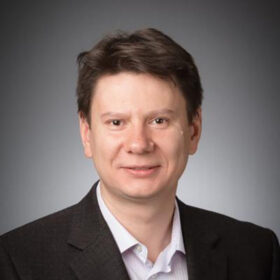
Associate Professor and Associate Chair, Undergraduate
Materials Science and Engineering
Overview
Our group utilizes a predictive physical modelling combined with today’s supercomputing power to evaluate intrinsic properties of new materials prior to their synthesis and characterization, thereby increasing the time- and cost-efficiency of the development process. The success of this approach relies on an ability of the theory to relate the atomic structure of novel compounds to their properties from first principles, i.e., ideally without any prior empirical knowledge. Modern density functional theory (DFT) is a core technique that enables quantitative evaluation of diverse physical properties and phenomena based on the electronic structure of matter obtained from first principles. We further advance the development of microscopic approaches to simulation and invention of advanced functional materials including optoelectronic and quantum materials.
3 units Elastic and Plastic Deformation of Materials. Strengthening Methods. Fracture Mechanisms. Fatigue and Creep failure. Three lectures, one lab (one hour) every other week; second term Prerequisite(s): ENGINEER 2P04 or CIVENG 2P04 and Registration in Materials Engineering; or MECHENG 2P04 and Registration in Mechanical Engineering; or permission of the department
Instructor
Dr. Oleg Rubel
TECHNICAL ELECTIVE LIST A 6 unit(s) Several written and oral reports are required in each term. The written thesis is defended orally. Nine unscheduled hours each week; both terms Prerequisite(s): Registration in Level IV or above in Materials Engineering and a GPA of at least 8.0 and permission of the department Antirequisite(s): MATLS 4KA3, MATLS 4KB3, IBEHS 3I06 A/B
Instructor
Dr. Oleg Rubel
TECHNICAL ELECTIVE LIST A 3 unit(s) Microscopic insight to the structure of functional materials used in photovoltaics, light generation, piezoelectronics and origin of their properties from atomic-scale simulations. One lecture (one hour) and One lecture (two hours); second term Prerequisite(s): Registration in Level III or above in Materials Engineering or Engineering Physics; or permission of the department Offered on an irregular rotation basis.
Instructor
Dr. Oleg Rubel
3 unit(s) Microscopic insight to the structure of functional materials used in photovoltaics, light generation, piezoelectronics and origin of their properties from atomic-scale simulations. One lecture (one hour) and One lecture (two hours); second term Prerequisite(s): Registration in Level III or above in Materials Engineering or Engineering Physics; or permission of the department Offered on an irregular rotation basis.