Canada Research Chair in Imaging and Spectroscopy of Advanced Nanomaterials using Electron Microscopy (Tier 2)
Overview
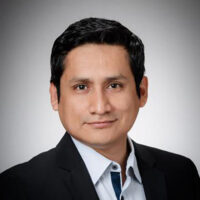
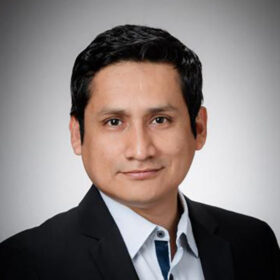
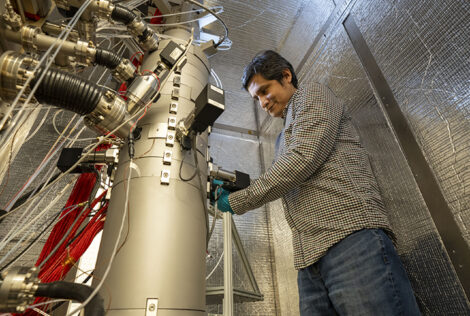
Dr. Lagos’ research is focused on the study of advanced material properties using imaging and electron spectroscopy techniques implemented in transmission electron microscopes. He investigates low-energy excitations (phonon, plasmons, excitons) and electronic transitions in novel materials with potential for infrared nanophotonics, semiconductor and quantum material applications. His group also develops novel methodologies for nanoscale material characterization (e.g. thermometry). Besides his interest in vibrational and electronic properties of nanomaterials using EELS, he has worked on temporal aspects of the inelastic electron scattering, quantum electronic transport, and mechanical elongation of nanostructures using in-situ TEM. Dr. Lagos holds the Canada Research Chair in Imaging and Spectroscopy of Advanced Nanomaterials using Electron Microscopy. He currently serves as Associate Scientific Director of the Canadian Centre for Electron Microscopy.
Research Areas Include:
• Transmission Electron Microscopy of advanced materials • Electron energy-loss spectroscopy of advanced materials (e.g. quantum materials, semiconductor materials, organic materials) and their excitations (phonon, plasmon, excitons) • Infrared nanophotonics • Nanoscale heat transfer • Correlation between structure-properties of nanomaterials
Ph.D. The State University of Campinas
Postdoctoral Fellow, University of Antwerp.
Research Associate, RUTGERS, The State University of New Jersey.
Canada Research Chair (2023)
Early Career Investigation Award from the Microscopy Society of Canada (2022)
NSERC Early Career Research Award (2019)
Microscopy & Microanalysis Postdoctoral Scholar Award (2018)
Invited Speaker Presentation Award – EDGE Meeting (2017)
Capes Best Thesis Prize, Category: Physics (2012)
3rd Paulo Gontijo Best Thesis Prize, Category: Physics (2011)
Marechal do Ar Casimiro Montenegro Filho Prize, Category: Nanoscience (2010)
Recent
Representative Publications:
Review on Advances in Ultra High Energy Resolution EELS: Phonons, Infrared Plasmons and Coupled Modes. Microscopy 71, i174 (2022).
Imaging and Spectroscopy of Strongly-Coupled Plasmon-Phonon Modes. ACS Photonics 8, 1293 (2021).
Nanoscale Temperature Measurements Using Phonon Spectroscopy. NanoLetters 18, 4556 (2018).
Mapping Surface and Bulk Phonon Modes in a Single Nanocube. Nature 543, 529 (2017).
Vibrational Spectroscopy in the Electron Microscope. Nature 514, 209 (2014).
Attosecond and Femtosecond Forces Exerted on Nanoparticles Induced by Swift Electrons. Physical Review B 93, 205440 (2016).
The Role of Electronic Coupling Between Substrate and 2D MoS2 Nanosheets in Electrocatalytic Production of Hydrogen. Nature Materials 15, 1003 (2016).
Mechanical Deformation of Atom-sized Metal Rods: When Size and Shape Matter. Physical Review Letters 106, 55501 (2011).
The Smallest Metal Nanotube with a Square Cross-section. Nature Nanotechnology 4, 149 (2009).
Related Courses
3 unit(s) Antirequisite(s): Permission of the instructor required. Introduction to transmission electron microscopy: electron sources, optics, TEM, Scanning-TEM, electron-solid interactions, diffraction, imaging, and spectroscopy. Course will include a practical component with demonstration labs.
Instructor
Dr. Maureen Joel Lagos
TECHNICAL ELECTIVE LIST A 3 unit(s) Interaction of electrons and photons with matter. Imaging methods with electron microscopy, scanning probe techniques, x-ray photoelectron spectroscopy and X-ray absorption analysis with high spatial resolution. Three lectures; first term Prerequisite(s): Registration in Level III or above in Materials Engineering, Chemical Engineering, Engineering Physics or Honours Chemistry; or permission of the department. Offered on an irregular rotation basis.
Instructor
Dr. Maureen Joel Lagos
3 unit(s) Antirequisite(s): Permission of the instructor required. Introduction to transmission electron microscopy: electron sources, optics, TEM, Scanning-TEM, electron-solid interactions, diffraction, imaging, and spectroscopy. Course will include a practical component with demonstration labs.