Engineering Physics and Biomedical Engineering – Faculty of Engineering

Engineering Physics and Biomedical Engineering

A unique integrated program delivered jointly by the Faculties of Engineering and Health Sciences, merging Engineering Physics with biomedical insights to tackle complex engineering problems.

Length
5 years
Degree
Bachelor of Engineering & Biomedical Engineering (Co-op Available)
Program
Integrated Biomedical Engineering & Health Sciences (iBioMed)
Options

Co-op

Overview

Engineering Physics & Biomedical Engineering combines the principles of physics with biomedical engineering to develop technologies that advance healthcare and improve human health. Through hands-on labs, design projects, and advanced engineering courses, you’ll explore areas such as medical imaging, nanotechnology, radiation and embedded systems. Graduates are prepared for careers in medical devices, imaging and instrumentation, consumer health technology, and advanced engineering or graduate studies.

Why study this program?

  1. Canada’s first undergraduate program integrating engineering physics with biomedical applications and entrepreneurship, preparing students to drive innovation in medical technology.
  2. Learn in a highly specialized environment focused on imaging, nanotechnology, radiation systems, and embedded devices, with strong emphasis on hands-on labs, design projects, and applied problem-solving.
  3. Graduate with in-demand skills for careers in medical devices, imaging and instrumentation, health technology companies, and advanced engineering roles across healthcare, energy, and emerging tech sectors.

What you'll learn

Study in an interdisciplinary field that combines engineering physics principles with biomedical engineering applications. You’ll build a strong foundation in core areas such as mechanics, electromagnetism, quantum physics, electronics, optics, and numerical methods, alongside biomedical systems including physiology, medical imaging, and health technologies.

All students in McMaster’s Integrated Biomedical Engineering & Health Sciences (iBioMed) program participate in a common first year — IBEHS 1. Build a solid base in the fundamentals of engineering, health and entrepreneurship and get exposed to design work at the start of your degree.

ENGPHYS 3BB3 – Embedding and Programming a Micro-Controller:

Learn how to program the “brains” inside real devices, from medical instruments to smart systems, through hands-on embedded systems design and development. 

IBEHS 3A03 – Biomedical Signals and Systems:

Explore how the body communicates through electrical signals such as ECG and EEG, and learn how engineers interpret these signals to support diagnosis and healthcare technologies. 

IBEHS 4F04 – Biomedical Instrumentation and Measurement:

Work with real biomedical devices and sensors used in healthcare, gaining practical experience in how technologies like imaging and monitoring systems are designed and tested.

Get practical experience and grow your portfolio with interdisciplinary design courses. All students in Integrated Biomedical Engineering and Health Sciences take six project-based design courses:

1. IBEHS 1P10 A/B – Health Solutions Design Projects I: Introduction to Engineering Fundamentals and Design 

2. IBEHS 2PA2 – Health Solutions Design Projects II-A: Lab Skills in Genetic Engineering

3. IBEHS 2PB2 – Health Solutions Design Projects II-B: Project in Genetic Engineering

3. IBEHS 3P04 – Health Solutions Design Projects III: Economic Analysis and Risk Management

4. IBEHS 4P03 – Health Solutions Design Projects IV: Decision Making and Project Management

5. Capstone project (year-long design project)

Potential career paths

Graduates will be career-ready for high-demand areas such as advanced technology, energy systems, telecommunications, materials, and space and quantum technologies. 

  • Electrical Engineer
  • Embedded Software Engineer
  • Manufacturing Engineer
  • Mechanical Designer
  • Nuclear Engineer
  • Product Developer
  • Quality Engineer
  • Research & Development Engineer

Explore Engineering Physics & Biomedical Engineering in grad school

You’ll already be connected to world-renowned researchers leading innovation in your undergrad: continue pursuing research and innovation in a master’s program.

  • World-Class Research Centres

    The CEDT facilitates study of the optical, electrical, mechanical, and biological properties of semiconductors and related materials and promotes the development of technology based on these materials. 

    Established in 1987 as the Centre for Electrophotonic Materials and Devices, the Centre for Emerging Device Technologies (CEDT) has grown into a leading hub for semiconductor and advanced materials research. Through significant investments in cutting-edge equipment and support from organizations such as NSERC and industry partners, CEDT developed world-class capabilities in materials growth, characterization, and device fabrication.
  • Clubs and teams

    McMaster has many clubs, teams and societies you can join to practice your engineering skills, get more hands-on experiences and explore new activities.
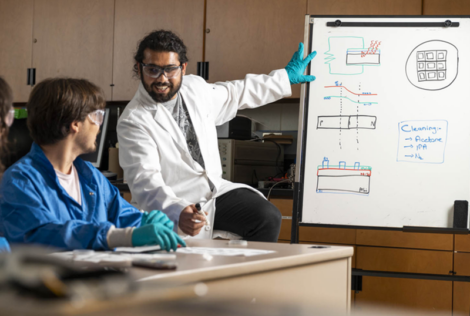
    McMaster Medical Engineering Design Team (MED-T) – Students collaborate on medical device design projects, applying engineering and health sciences knowledge to solve real-world healthcare challenges through innovation and hands-on development.
    Learn more about Mac Eng Experiences
  • Canada's largest undergraduate research program

    Engage in hands-on research and complex problems with a mentor as early as your first year.

    Faculty of Health Sciences Getting the dosage right: $1.2M awarded for diagnostic tech that could transform mental health care Researchers are developing rapid diagnostic tools that could reduce drug-monitoring wait times from 15 days to 10 minutes, enabling faster, more personalized mental health treatment.
    Learn about health science research

More helpful links