Visual communications, image and video compression, image/video indexing and retrieval, robust video transmission over error prone networks, image and video processing, VLSI architectures for real-time signal and image processing, multimedia hardware architectures, ultrasonic imaging
L.R. Wilson/Bell Canada Chair in Data Communications
Electrical & Computer Engineering
Associate Member
McMaster School of Biomedical Engineering
Overview
My research focuses on multimedia communications and image/video processing. The overall goal of my research is to find schemes to improve digital media (e.g., image, audio, video) communication across different types of networks. In particular, my research focuses on pre-processing, source coding (compression), quality assessment and post-processing of digital media. Thanks to the rapid growth of technology in the past two decades and popularization of digital devices, multimedia has become an inseparable part of our daily lives. People can access digital media via different devices ranging from televisions and computers to mobile devices. The applications of multimedia communications include: entertainment (TV, cinema), education, biomedicine and education to name a few.
Did you know?
A video pre-processing scheme developed by Dr. Shirani is used by a number of TV networks in Canada and US.
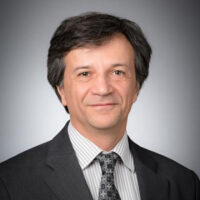
Dr. Shahram Shirani received his Bachelor of Engineering in Electrical Engineering from Isfahan University of Technology, Iran, and his Master of Science (with honours) in Biomedical Engineering from the Amirkabir University of Technology, Iran and his Ph.D. in Electrical Engineering from the University of British Columbia, Canada in 1989, 1994 and 2000, respectively. Since July 2000, he has been with the department of Electrical and Computer Engineering, McMaster University where currently he is a professor and holds Wilson/Bell Canada chair in Data Communications. His research is mainly focused on image and video processing, multimedia compression and communications, medical image processing and hardware architectures for image and video processing. He was an Associate Editor and member of the editorial board for IEEE Transactions on Multimedia and an Associate Editor and is a member of the editorial board for IEEE Transactions on Circuits and Systems for Video Technology.
B.Sc. (Isfahan University of Technology) ; M.Sc. (Amirkabir University of Technology) ; Ph.D. (University of British Columbia, Canada)
P.Eng.
L. R. Wilson/Bell Canada Chair in Data Communications (2012-present)
Faculty of Engineering Leadership Fellow 2014-2015
Selected
N. Faramarzpour, M.J. Deen, S. Shirani, Q. Fang, L.W.C. Liu (2007)
IEEE TRANSACTIONS ON CIRCUITS AND SYSTEMS FOR VIDEO TECHNOLOGY 17 (10)
Recent
H. Rezaee, S. Shirani, “Frame Rate Up-conversion Using Optical Flow and Patch-Based Reconstruction”, IEEE Transactions on Circuits and Systems for Video Technology, Volume 26, Issue 9, Pages: 1581 – 1594, 2016.
N. Karimi, S. Samavi, M. Soroushmehr, S. Shirani, K. Najarian, “Toward practical guideline for design of image compression algorithms for biomedical applications”, Expert Systems with Applications, Volume: 56, pp. 360-367, Sep. 2016.
H. Sadeghi, S. Valee, S. Shirani, “2DTriPnP: A simplified and robust two-dimensional method for fine visual localization using Google streetview database” IEEE Transactions on Vehicular Technology, Volume 66, Issue 6, Pages: 4678 – 4690, 2017.
F. Shafieyan, N. Karimi, B. Mirmahboub, S. Samavi, S. Shirani, “Image Retargeting Using Depth Assisted Saliency Map”, Signal Processing: Image Communication, Volume 50, February 2017, Pages 34-43.
3 unit(s) Central to computer vision are the mathematical models governing image formation and methods for processing and recovering information based on the model and the image data. In this course we concentrate on statistical and geometrical models of visual data. Assuming a statistical model for the visual data, we talk about learning and inference. We cover modeling of the data densities, regression and classification methods and how we can use graphical models (e.g., Vitterbi, belief propagation) to solve learning and inference problems. In the other half of the course we take a geometrical approach to image formation and look at problems such as image blending and stitching and 3D reconstruction.
ELECBME 5P06 A/B – Integrated Electrical & Biomedical Engineering Capstone Design Project 6 unit(s) A multidisciplinary engineering design project involving design and synthesis that reinforces concepts from both Electrical Engineering and Biomedical Engineering. Two lectures; both terms Prerequisite(s): IBEHS 4P04 and registration in Level V of the Electrical and Biomedical Engineering program; or permission of the instructor. Antirequisite(s): IBEHS 5P06 A/B Cross-list(s): CHEMBME 5P06 A/B, CIVBME 5P06 A/B, EPHYSBME 5P06 A/B, MATLSBME 5P06 A/B, MECHBME 5P06 A/B, SFWRBME 5P06 A/B, TRONBME 5P06 A/B
The design process; safety; a term project composed of small teams of students including an oral presentation and written report. Lectures, tutorials, one capstone project; both terms Prerequisite(s): Registration in Level IV or V of any Electrical or Computer Engineering program Antirequisite(s): ELECENG 4BI6 A/B, ENGINEER 4M06 A/B, IBEHS 5P06 A/B