
For Timothy Warner, one of the biggest perks of being a postdoctoral fellow is the freedom and flexibility to explore different research projects.
“As a postdoctoral fellow, you can take on a broad and diverse range of projects that don’t have to connect,” says Warner. “When you’re working on your PhD, your work has to be very focused, and your projects have to be interconnected so you can write your thesis.”
That’s how Warner came to be involved in research at McMaster spanning a multitude of research clusters, from membrane development to gas adsorption to water purification. Warner, who originally hails from Melbourne, Australia, first set his sights on McMaster’s Chemical Engineering program after connecting with Charles de Lannoy.
“I came across his research and found similarities with what I had done and what interests me, so I reached out to him,” says Warner. That’s how Warner found himself across the world in Hamilton, Ont., working at the McMaster Regional Centre for Mass Spectrometry (MRCMS) and the university’s other state-of-the-art facilities.
Breaking down ‘forever chemicals’
Warner has been working closely with IBA, a Belgium-based company committed to tackling global environmental challenges through innovative technologies. With IBA, Warner is exploring the degradation of PFAS – also known as ‘forever chemicals’ – using electron beams.
PFAS (per- and polyfluoroalkyl substances), are a group of manufactured chemicals known for being water- and oil-repellent and extremely long-lasting in the environment. There are questions surrounding the safety of PFAS, which are thought to be toxic and carcinogenic.
“Removing these chemicals from water has been a focus of mine,” says Warner. “You can adsorb the PFAS onto activated carbon, which I’ve done in our lab, and I’m working with IBA, who are able to actively destroy PFAS with high-energy electrons.”
Gas adsorption analyzer
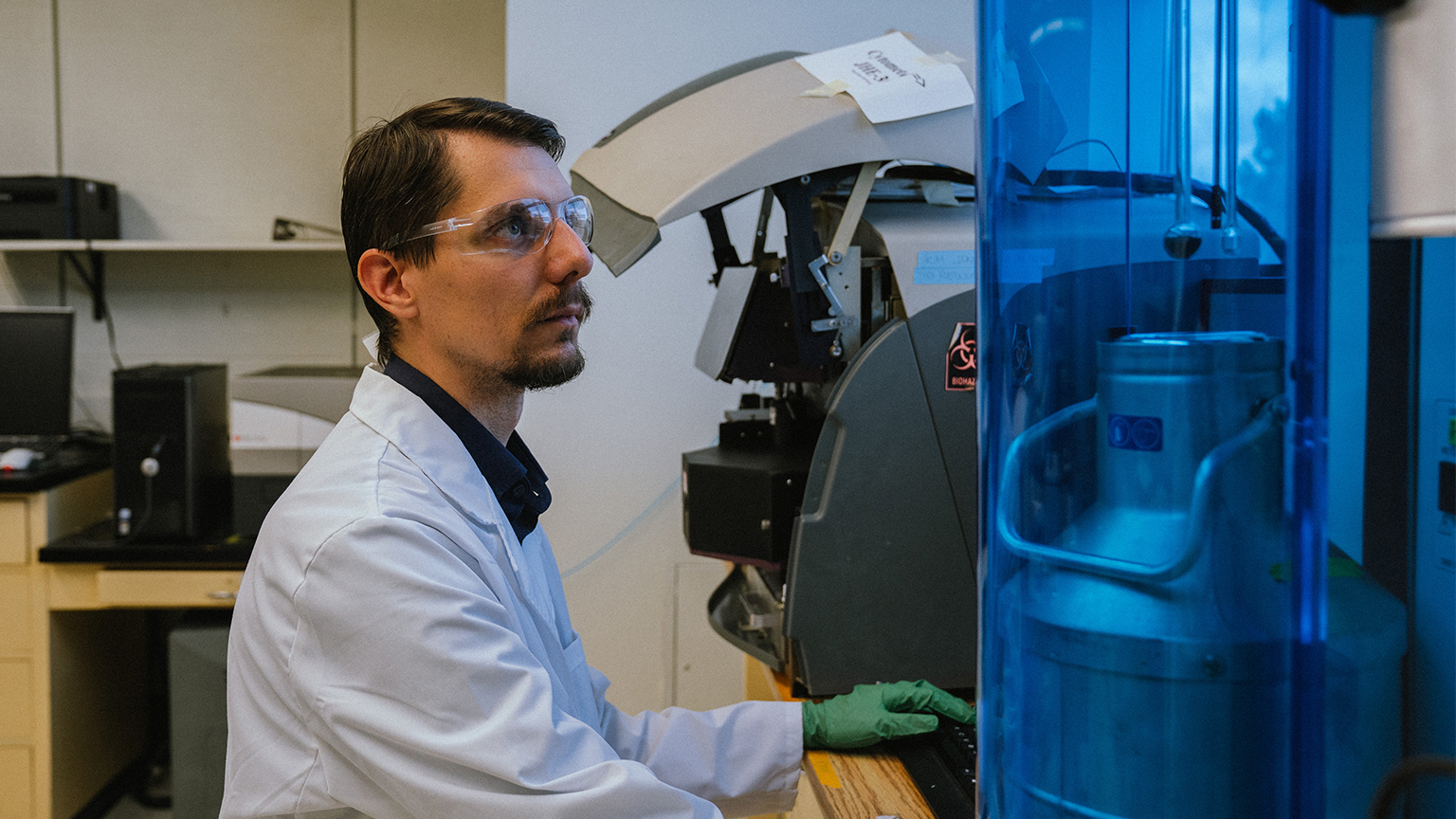
While at McMaster, Warner has been managing a gas adsorption analyzer that can be used to measure porous materials, like activated carbon.
“We can measure how much nitrogen gas an activated carbon can adsorb, which is related to its surface area,” he says. “This device can also measure the size and volume of the pores.”
Warner uses the instrument to conduct his own research and trains other researchers on how to use it too.
“I get to help people and find out about different projects,” he says. “We also get a lot of interest from industry partners who want to investigate biocarbons for steelmaking and other applications.” This includes helping industry partners generate ‘green steel’ by replacing coal with biocarbon, producing significantly lower carbon emissions than traditional methods.
A new water membrane system
Warner also helped to invent a new device for measuring water membranes.
“Membranes can be a flat shape, like a coffee filter, that you can use to filter wastewater through to clean the water – either for drinking or for release into the environment,” says Warner. “The most common method in the industry is to use porous, hollow fibres”
Previously, industry partners didn’t have a device to measure individual fibres to see how much water could pass through. This new device can now measure the flow of water through these individual membranes.
“It’s a unique device that our students can use, as we have students who are making their own fibres in a novel way,” says Warner. “Having this device in our lab, we can directly measure the fibres we are making, closing the loop from creation to validation.”
Sustainability is at the centre of our thinking. With the hollow fiber testing device, we can more effectively develop processes for separating contaminated water from clean water. This gives us more advanced and efficient ways to have cleaner water for us and for the environment.
Exploring the natural beauty of Hamilton
When not busy in the lab or mentoring other students, Warner enjoys exploring all that Hamilton has to offer.
“I love the campus, the beautiful buildings and that we have a forest right in our backyard,” says Warner. “And being able to ice skate on Cootes Paradise is exciting to me. I don’t think there’s a single place in Australia you can skate on a lake or body of water, so that’s been a unique experience for me.”
Postdoc Fellows in Focus is a story series that highlights the impactful contributions of postdoctoral fellows within McMaster’s Faculty of Engineering. Through their research, mentorship of undergraduate and graduate students and contributions to research culture, these fellows play a vital role in advancing innovation and supporting the next generation of engineers.