





Expertise
Phage-biomaterial & phage-device combinations; Phage processing stability; Phage preservation; Phage self-organization; In vitro and in vivo models for phage therapy; Phage spray drying; Phage aerosolization; High throughput assays and biosensors with bacteriophages; Phage hydrogels, microgels, microneedle patches, films, fibers, aerosols, and powders;
Areas of Specialization
Research Clusters
Current status
-
Accepting graduate students
-
Associate Professor
Chemical Engineering
-
Associate Professor
McMaster School of Biomedical Engineering
-
Canada Research Chair in Bacteriophage Bioengineering (Tier 2)
Chemical Engineering
Overview
Bacteriophages are viruses that target and kill bacteria. These natural antimicrobial are very effective and could be our last beacon hope in a post antibiotic future.
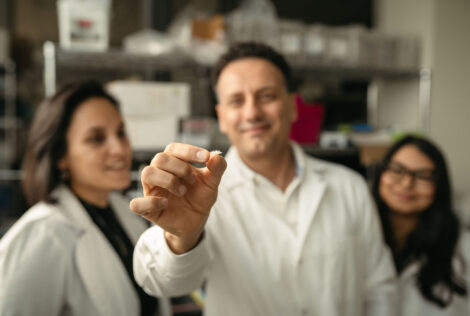
To be effective as antimicrobials in different sectors such as healthcare, agriculture, and food chain, bacteriophages must be turned into products that meet industry/medical standards. This is were we come in; the core mission of a chemical engineer is to transform raw materials into useful products. My lab strives to develop scalable technologies that enable integration of bacteriophage antimicrobials into healthcare and beyond. We have a diverse intellectual property portfolio built around impactful scientific publications. Please see my lab website (link on this page) for a detailed list of technologies available for licensing and more information about our research.
If you are a self-driven and innovative individual who likes to think outside the box and is considering applied research at the graduate or undergraduate level, please contact me with your CV and transcripts. If you are a researcher in academia or industry who likes to talk about phages, I would be happy to hear from you.
Research platforms
Platform A: Phage Antimicrobials
We use bacteriophages for their inherent property, as bacterial killers. We develop design/formulation criteria for bacteriophage therapeutics against common infections on the skin, medical implants, gastrointestinal tract, and respiratory system, specifically those that are in biofilm mode and antibiotic resistant.
Platform B: Phage Biomaterials
In their simplest form, bacteriophages are bionanoparticles than can propagate themselves and self-assemble. These properties make bacteriophages more powerful than synthetic nanoparticles. We also pack bacteriophages into solid form to design antimicrobial biomaterials, gels and coatings.
Platform C: Phage Diagnostics
Bacteriophages are very effective at finding and specifically targeting their host bacteria in nature. Because bacteriophages are so good at targeting their prey (bacteria) in nature, we use them to design novel methods of detecting and diagnosing infectious diseases.
Platform D: Aerosolized Phage
We investigate aerosolized phage to understand the behaviour of infectious aerosols, as well as to design inhalable therapeutics. We research the performance of respirators to aerosolized viruses and bacteria under clinically relevant conditions.
Did you know?
Phages have been named the next “Trillion Dollar Idea In Biotech”. Bacteriophages, or phages for short, are viruses that target bacteria. If you want to learn more about phages, visit our lab website: https://www.hosseinidoustlab.com/resources
I am a chemical engineer turned bioengineer. My lab is recognized for research excellence by the Canada Research Chairs program and the Ontario Early Researcher Award and featured by pubic media around the globe. My research program is interdisciplinary and thus inherently collaborative. I am a core member of The Farncombe Institute for Digestive Health and an associate member at the Michael DeGroote Institute for Infectious Disease Research, the School of Biomedical Engineering, and the Center for Protective Equipment and Material (CEPEM), as well as the Brockhouse Institute for Materials Research. My lab Alumni are leadig innovation in academia as well as the pharmaceutical and healthcare sectors.
- PDF, Max Planck Institute for Intelligent systems, Germany
- Ph.D., McGill University, Montreal, Canada
- B.Sc. & M.Sc., Sharif University of Technology, Iran
- Canada Research Chair (T2) in Bacteriophage Bioengineering
- Ontario Early Researcher Award
- Dean’s Honor Roll for Teaching Excellence