McMaster Engineering graduate honoured with the 2022 James Dyson Global Sustainability Award
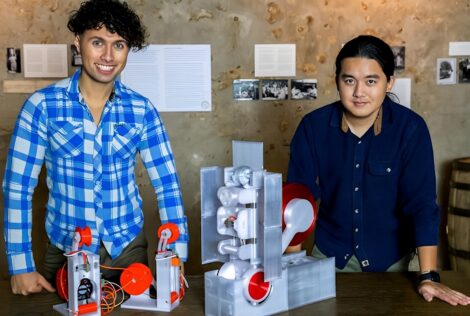
Swaleh Owais and Yang Cheng won top honour for the creation of Polyformer, a machine that recycles plastic bottles into 3D printer filament.

Students take on a major mechanical project including quantitative design analysis, optimization, validation and/or testing.
The projects are a culmination of the students’ years of rigorous undergraduate study.
Team #1: RA01
This project involves designing an autonomous robot for cleaning city parks by detecting garbage using computer vision, moving toward it, picking it up, and compressing it for efficient waste management. The robot aims to reduce human effort in park maintenance while promoting a cleaner and more sustainable environment.
Team members: Salih Al-Tak, Valerie Stephens, Devin Stukel, Jerry Liu
Capstone advisor: Ryan Ahmed
Team #2: RA02
Our team believes that access to clean drinking water is a fundamental human right and critical component of public health. Despite that, approximately 26% of the global population lacks access to safely managed drinking water services. Within this industry, technological advancements have given birth to autonomous water quality monitoring solutions, but these products can cost between 4 and 6 figures per unit. Our team has designed an inexpensive sensor-suit package that can be installed on to small-scale remote controlled boats to allow it to monitor various water quality parameters, travel autonomously to a preset location, and feed live data back to the user.
Team members: Vega (Bima) Purwantoro, Mohamed Morad, Chuntian Jiang, Zihan Cao
Capstone advisor: Ryan Ahmed
Team #3: RA03
We have designed, built and tested a wheeled mobile robot for autonomously extinguishing fires.
Team members: Seth Chin, Luciano Jakubczyk, Riho Sikes, Michael Ferlisi
Capstone advisor: Ryan Ahmed
Team #4: RA04
We designed and built a mobile weed removal robot equipped with AI-driven image detection to identify and extract weeds. The system utilizes a drill mechanism for removal and a vacuum for collection, ensuring efficient and automated weed management.
Team members: Jaxen Nilsson, Jackson Chung, Abhi Kamath, Matthew Zhang
Capstone advisor: Ryan Ahmed
Team #5: MA01
The design of a device to cyclically load an off-road vehicle suspension based on collected input data from a wheel force transducer.
Team members: Grace Worfolk, Emily Ing, Ariel Wolle, Ben Waldie
Capstone advisor: Maryam Aramesh
Team #6: MA02
We have designed, built and tested an automated conveyor system for electroplating different cutting tools.
Team members: Milad Darrouj, Mostafa Aga, Ziad Ahmad, Ali Elsheikh
Capstone advisor: Maryam Aramesh
Industry advisor: MDA Space
Team #7: MA03
We have designed, fabricated, and tested a control system for a Minimum Quantity Lubrication system that uses cutting force readings from a dynamometer to actuate lubricant spray. This functionality reduces the consumption of lubricant when machining difficult-to-cut materials and will be used as a research tool with the goal of achieving similar, if not better machining performance than traditional flood cutting.
Team members: Jason Lowrie, Hana Amari, Eleanor Gough, Luc Nusselder
Capstone advisor: Maryam Aramesh
Team #8: MA04
Design and build a handheld, functional, commemorative torch that symbolizes Canada’s accomplishments and values.
Team members: Thivean Uthayaharan, Ahees Yokkumar, Shashank Sharma
Capstone advisor: Maryam Aramesh
Industry advisors: McMaster Manufacturing Research Institute and the Canadian Remembrance Torch (Karen Hunter)
Team #9: GB01
A pneumatic robot inspired by the movement of worms though soil with the objective of navigating though rubble to find survivors after natural disasters such as earthquakes. The design makes use of various soft pneumatic actuators and auger-inspired elements to enable controlled movement through difficult terrain.
Team members: Amanda Gomes Martins, Suzanne Nelson, Samuel Park, Sunghyun Lee
Capstone advisor: Gary Bone
Team #10: GB02
The Smart Gripper for Human-Robot Teamwork is a device that engages in grasping and robot-to-human/human-to-robot object handover tasks. In addition to this, the gripper will apply the minimum force to hold the object being received by incorporating a slip detection system.
Team members: Tyler Bambford, Catie Scott, Lucas Popiez
Capstone advisor: Gary Bone
Team #11: GB04
A pneumatic robot arm designed to perform a pick and place motion of a 3kg mass while abiding by CSA-ISO Standards.
Team members: Matthew Gram, Zixu Wang, Markus Rogina, Cavan Stewart
Capstone advisor: Gary Bone
Team #12: GB05
Launch continues to be a driving design requirement for space technologies. In addition to the usual mass and volume requirements, the faring size of a launch vehicle also puts limits on the size an arm can grow to. Using Canadarm2 heritage, this capstone project seeks to explore foldable robot arm booms and develop a folding system proof-of-concept.
Team members: Shawn Braley, Alex Murva, Ethan Brandon
Capstone advisor: Gary Bone
Industry advisor: MDA Space
Team #13: JC01
The project involved the design, building, and testing of a drying apparatus used to characterize the drying of potash with various technologies. The apparatus was built to test the effectiveness of hot air, infrared heating, and induction heating in drying potash.
Team members: Obada Al-Sayed, Waleed Al-Basha, David Ackah, Yousef Afifi
Capstone advisor: Jeffrey Girard
Industry advisor: BHP Group Ltd.
Team #14: JC02
We have designed, built and tested an exhaust system that will be used to harness thermal energy from a conveyer oven, used in quick service restaurants such as Pizza Pizza. The system captures hot exhaust gases for thermal recovery and then allow the gases to be properly discarded through existing restaurant exhaust infrastructure. Our system includes utilizing an existing heat reclaimer to optimize hot exhaust gas flow through the system and maximize thermal energy returns.
Team members: Pierre Sedarous, Fathma Syed Fouwaz, Rachel Diniz
Capstone advisor: Jim Cotton
Team #15: JC03
This project consists of designing a lift system for storing a 24-foot harvest table and a counterbalance chandelier fixture in a carport.
Team members: Rhea Gandhi, Kirpa Patel, Kavi Gurunathan, Zitong Zhao
Capstone advisor: Jim Cotton
Team #16: JC05
We are developing a surface-mounted sensor system and heat transfer model that allows facility staff to easily and accurately estimate internal pipe temperatures across various materials and sizes, enabling reliable thermal performance analysis.
Team member: Ellanko Ramasamy, Adrian Brothers, Asad Rahman
Capstone advisor: Jim Cotton
Team #17: DC01
We have designed, built, and tested a shredding device that can shred PLA and PET plastics down to 0.5 inches in size.
Team members: Lucas Di Cosmo, Rudresh Patel, Joshua Ocampo, Haobo Zhang
Capstone advisor: Duncan Cree
Team #18: DC02
We designed and built a desktop plastic pulverizer that reduces recycled plastic into small granules, enabling reuse in material processing applications.
Team members: Jeremiah Musselman, Matthew Trochanowski, Joshua Treptau, Calum Oliver
Capstone advisor: Duncan Cree
Team #19: DC03
Our project automates the process of ice fishing using various motors, sensors and mechanical components in order to jig fishing lures, detect bites, set the hook into a fishes mouth, and retrieve the fish once caught. This allows researchers to collect important data on fish patterns and habits during the winter months when traditional methods are not possible.
Team members: Ethan DeNure, Davin Hoard, Nicholas Marino, Josh Currie
Capstone advisor: Duncan Cree
Team #20: DC04
Robotic arm controlled by tension in cables and motors situated at base, to delocalise weight.
Team members: Eniolaoluwa Adebayo, Jalal Ehsani, Samuel Ogundare, Leo Ren
Capstone advisor: Duncan Cree
Team #21: TD03
Robotic arm controlled by tension in cables and motors situated at base, to delocalise weight.
Team member: Jabez Hong
Capstone advisor: Tohid Didar
Team #22: TD04
Design of an automated braiding machine for the braiding of polymer based sutures. Assembly of a table-top device that can output braided sutures with the careful input of individual PLGA fibers.
Team members: Patrick Grant, Rohith Ram, Muhammad Malik
Capstone advisor: Tohid Didar
Team #23: SH04
Design and build a fixture for automated and rapid exchange of size 2170 battery cells. Scan and record bar codes, test cells then sort cells based on result of test.
Team members: Rachel Vieyra, Fraser Macfarlane, George Moise, Ryan Abraham
Capstone advisor: Saeid Habibi
Team #24: SH05
The project requires a computer simulation of the first three links of the PUMA 560 robot (base, upper arm, and forearm) using its existing electrical actuators. The simulation model is then to be changed with the replacement EHA system for base rotation that is to be designed.
Team members: Solomon Mei, Yangfei Wang
Capstone advisor: Saeid Habibi
Team #25: EH01
We have designed, built and tested a continuous water velocity measurement apparatus in an aquatic environment
Team members: Judge Cao, Jacob Mathers, Basil Sorial, Lucas Picard
Capstone advisor: Elizabeth Hassan
Team #26: EH02
We have created a system that allows Zebra fish to swim in smooth water at a constant speed with the goal of comparing the results against human data in the future.
Team members: Emilie Alain, Anthony Mercieca, Salomé Grajales
Capstone advisor: Elizabeth Hassan
Industry advisor: Alex Little (Department of Biology)
Team #27: EH03
Optimizing the pre-processing for converting PET bottles into uniform plastic strips to be made into 3D printing filaments.
Team members: John (Billy) Webster, Maryam Chaudhry, Sandy Diep
Capstone advisor: Elizabeth Hassan
Team #28: EH04
We have designed and built a suspension system that mechanically decouples the roll and heave vehicle modes. This allows us to have greater control over the tuning parameters of our Formula SAE car, enabling us to maximize cornering performance and aerodynamic grip.
Team members: Nathan Sheogobind, Luca Panziera, Sepehr Makarian Abdolahi
Capstone advisor: Elizabeth Hassan
Team #29: PK02
We have designed, built and tested a multi-use hip stretching device for commercial gym use.
Team members: Kamran Coovadia, Evan Benko, Zakrea Shirzad, Justin Dennehy
Capstone advisor: Philip Koshy
Team #30: PK04
An EDM ram head attachment that supports multiple tools that work synchronously to minimize machining idle time during purge cycles.
Team members: Ethan Julian, Michael Beg, Liam McNeely
Capstone advisor: Philip Koshy
Team #31: CM01
We have designed and built a testing stand and evaluated the performance of an electric ducted fan at varying angles of attack.
Team members: Ben Stone, Marko Sacka, Jamie Mann
Capstone advisor: Christopher Morton
Team #32: CM02
An improved experimental system designed to gauge the thrust performance and acoustical performance of electric ducted fans. This is accomplished through a 2-axis force sensor made from a custom strain gauge array, and a condenser microphone with extensive signal processing.
Team members: Giulio Puglielli, James Smissen, Jason Lefneski, Gabriel Devries
Capstone advisor: Christopher Morton
Team #33: CM03
The design and build of a planar jet facility for the testing of stratified flow behaviours through laser induced fluorescence techniques.
Team members: Kate Brophy, Cora Vince, Áine Willis, Finn Turner
Capstone advisor: Christopher Morton
Team #34: Team MERCuRy: Canadian Reduced Gravity Experiment (CAN-RGX) Project
The McMaster Engineering Reduced gravity expeRiment aims to bring the SEDS Canadian Reduced Gravity Experiment (CAN-RGX) in partnership with SEDS Canada, the National Research Council, and the Canadian Space Agency to the classroom. This particular experiment, which is made possible with the partnership of MDA Space, aims to create an apparatus that can mix and form lunar concrete in microgravity so the technology can be used for In Situ Resource Utilization (ISRU) when building architecture on the moon. Once built, the experiment will be tested onboard the NRC Falcon 20, where 20 seconds of weightlessness can be achieved per parabola, pushing the bounds of the experiment to space-like conditions. The mechanical device, which can be no bigger than a commercial medium Pelican case, will involve an agitation apparatus and chamber to mix a low amount of binder with lunar regolith simulant, a valve to push the mixed material into a mold, and a removal mold for block curing. This is all encased in an aluminum extrusion structure to help withstand 2G loads. To go to the moon and stay there for many years to come, experiments such as this one will help pave the way to a more sustainable, scientifically fruitful lunar future!
Team members: Angela Tollis, Aria Kennaley, Gabriel Cino, Kristen Di Loreto, Slader Moon
Capstone advisor: Christopher Morton
Industry advisor: MDA Space
Team #35: ST01
We have designed, built and tested a laminar flow water tunnel to study flow oscillations that occur in irregular cross-sections.
Team members: Ishan Talati, Nima Naderiheshi, Jason Hu
Capstone advisor: Stephen Tullis
Team #36: ST02
In collaboration with McMaster Rocketry, this capstone project develops a pressure testing and fill system for a nitrous oxide fuel tank used in the team’s hybrid rocket competing in the international Spaceport America Cup 2027 10K Student Researched and Developed category. The project ensures that the oxidizer fuel tank meets competition safety and performance requirements through a robust pressure testing system. A custom fill system cart, equipped with tubing, valves, and dedicated housing for necessary fuel tanks, enables efficient fueling and rapid defueling in emergency situations.
Team members: Ashraful Hoque, Matthew Cheung, Conor O’Reilly, Laksh Anand
Capstone advisor: Stephen Tullis
Team #37: ST06
We have designed, built, and tested an improved footplate for the Oar Board SUP Rower to enhance the user’s experience on the water.
Team members: Maeve Bailey, Hana Franklin
Capstone advisor: Stephen Tullis
Team #38: SV01
Based on the mechanical contracting bid completed in the first term for the HVAC modifications of a medical research building we are optimizing the performance of the active chilled beam cooling system.
Team members: Erin Chillingworth, Jared Montgomery, Ryan Neudorf, Nour Abdallah, Puisand Lai
Capstone advisor: Stephen Veldhuis
Team #39: SV02
Design of a device used to assist in tasks requiring repetitive hand and arm movements over a workpiece. This device is meant to provide support to the user’s arms, while still allowing a user to move freely about the workspace.
Team members: Amara D’Souza, Jiaxin Zhang, Kaixuan Feng
Capstone advisor: Stephen Veldhuis
Team #40: SV03
We have designed, built, and integrated a damping mechanism into a repetitive motion assist device for users with hand tremors.
Team members: Tyler Mackenzie, Anshul Keswani, Leonard Ansari
Capstone advisors: Stephen Veldhuis, Kyle Lytwyn
Team #41: SV04
We have analyzed, designed, built and tested a thermoelectric cooling system for the purposes of chemotherapy scalp cooling.
Team members: Abby Richardson, Emma Smith, Stephanie Cinelli, Ciaran Ingram
Capstone advisor: Kyle Lytwyn
Industry advisor: NEMU
Team #42: FY01
This project will overlook the design and testing of a long reach, mechanically driven device that can deliver tools in a nuclear environment. It will outline current designs in industry as well as some unique design concepts that can achieve the project requirements. Designs will be explored using CAD software, decision matrices and basic hand calculations to justify the optimal solution. A prototype of the mechanism will be manufactured and tested as proof of concept.
Team members: Victor Deng, Kaihin Lau, Brandon Tam, Gihan Fernando
Capstone advisor: Fengjun Yan
Industry advisor: Westinghouse Electric Company
Team #43: FY03
We have designed and tested a small motorized cart capable of attaching to and driving around golf push carts.
Team members: Holden Shenfield, Jaasim Ansar, Zhiyuan Zheng, Zhicheng Wang
Capstone advisor: Fengjun Yan
Team #44: FY05
We have designed, built and tested a wheel-legged robot that can drive and jump. The combination of driving and jumping abilities allows the robot unparalleled mobility and maneuverability.
Team members: James Zhang, Steve Joseph, Kieran Gandhi, Zihan Li
Capstone advisor: Fengjun Yan