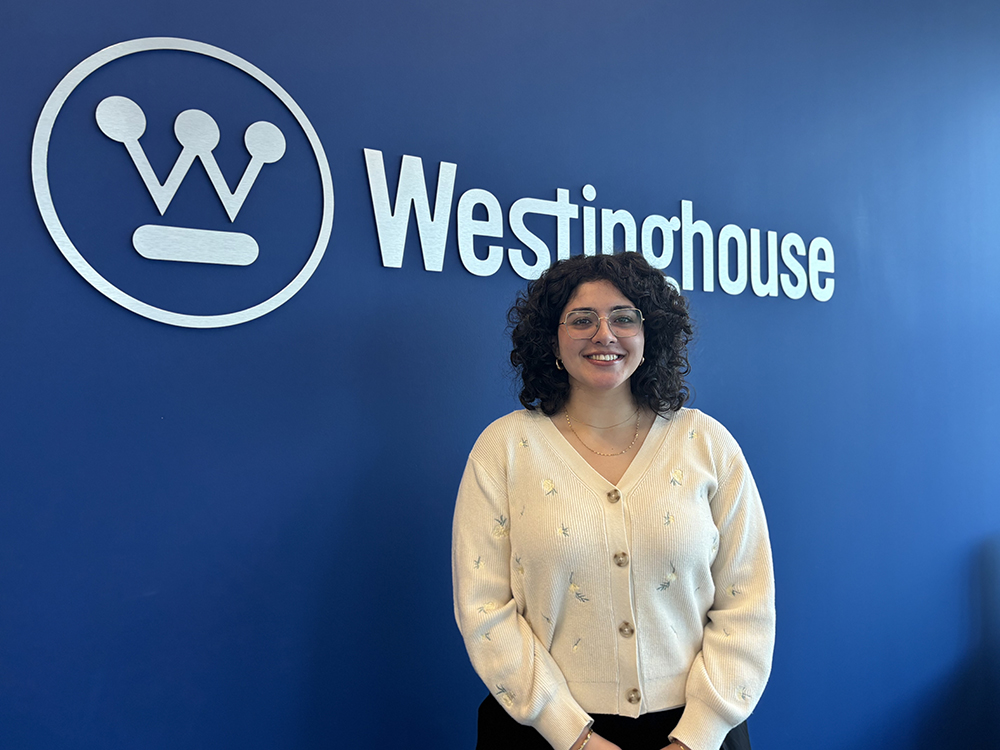
After graduating with an Engineering Physics and Biomedical Engineering (iBioMed) degree from McMaster in 2023, Saher Aslam has built a career defined by tackling complex challenges, driving collaboration and creating real-world impact.
Now working in systems engineering at Westinghouse, Saher plays a key role in supporting the design and development of custom tooling for nuclear reactors. Her work spans the full design lifecycle, from defining scope and requirements with customers to analysis, testing, validation and ensuring strict compliance with industry standards.
Alongside this technical work, she also contributes to improving internal engineering systems and processes, helping make complex work clearer and more efficient for engineering teams.
Deeply involved in the McMaster Engineering community during her undergrad, Saher participated in undergraduate research as well as leadership roles on a variety of clubs and teams and that shaped her multidisciplinary mindset.
More recently, Saher decided to give back to her alma mater by participating as a mentor at McMaster Engineering’s annual career networking event, Backpack to Briefcase.
I remember feeling lost at times as a student, and information wasn’t always easy to find. If I can share what I’ve learned and make that process easier for someone else, that feels meaningful. It’s very much a full-circle moment.
In her Alumni Blueprints Q&A, Saher reflects on her journey into systems engineering, the value of a multidisciplinary education, the impact of community at McMaster and the lessons she’s learned along the way.
Can you tell us about your current role in systems engineering at Westinghouse and what drew you to this field?
My role has two main aspects. The first is managing the design lifecycle for custom tooling used in nuclear reactors. That starts at the very beginning with defining and clarifying the scope with the customer, then moves into analyzing the tool to ensure it meets all industry requirements, followed by testing and validation before it’s delivered to the customer site.
My main responsibility throughout that process is ensuring compliance, safety, and quality from start to finish.
The second aspect of my role focuses more on the systems within the company. I help ensure that engineering processes and requirements are clear, easy to follow, and optimized. That involves identifying gaps, troubleshooting issues, and improving workflows so engineers can do their work as effectively as possible while still meeting organizational goals.
I didn’t necessarily set out to become a systems engineer. I came from a very multidisciplinary academic background, and I realized over time that I really enjoyed being able to understand high-level details across different disciplines and apply them to a bigger picture or vision. That’s exactly what I do now, so in many ways, I just ended up here.
What has been your proudest accomplishment in this role so far?
One of my proudest accomplishments was supporting the design and development of a contingency tool for use on a nuclear reactor. I was deeply involved in the testing process, working hands-on with hydraulic power units, high-speed cutting tools, and troubleshooting issues as they came up.
This project involved months of testing and collaboration, especially since it touched on mechanical engineering, which wasn’t my primary discipline. I had to seek out the right people, ask a lot of questions, and work through challenges along the way.
In the end, I completed the testing and delivered a detailed report that the customer accepted. The tool was successfully deployed and used on the reactor face to support refurbishment work. Seeing something I worked on so closely actually being used in a real reactor was incredibly rewarding.
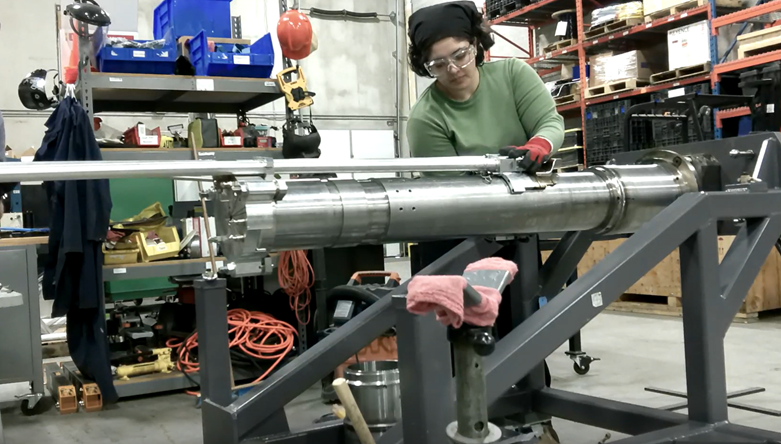
Saher working with a fuel channel mock-up during design verification testing of a custom tool
How did your Engineering Physics and Biomedical Engineering degrees, along with your leadership roles in the Eng Phys Society, prepare you for the real world?
Both programs were very multidisciplinary and academically challenging, which forced me to understand different perspectives across disciplines. I really took advantage of the flexibility they offered, especially Engineering Physics, which allowed me to explore a wide range of subjects.
That experience helped me develop the ability to quickly pick up on the nuances of different disciplines. Now, when I’m working with mechanical, electrical, quality assurance, or management teams, I’m able to follow along, identify gaps, and help bridge them so we can move toward a final product together.
Leadership roles, particularly within the Engineering Physics Society, also played a big role. They taught me how to understand the needs of others and translate those needs into practical outcomes, whether that meant organizing events, planning initiatives, or building community. All of that has translated directly into how I approach teamwork in my career.
Can you share how your involvement in extracurriculars at McMaster, including the Mac Eng Musical, shaped your experience?
Looking back, I was involved in almost everything I could be. I volunteered for events, joined committees, and took on leadership roles wherever possible. That mindset has carried into my professional life as well.
Being part of groups like Women in Engineering allowed me to help organize events and build a supportive community, particularly in a male-dominated field. I’ve stayed connected with many of those people since graduating, and those relationships continue to be meaningful.
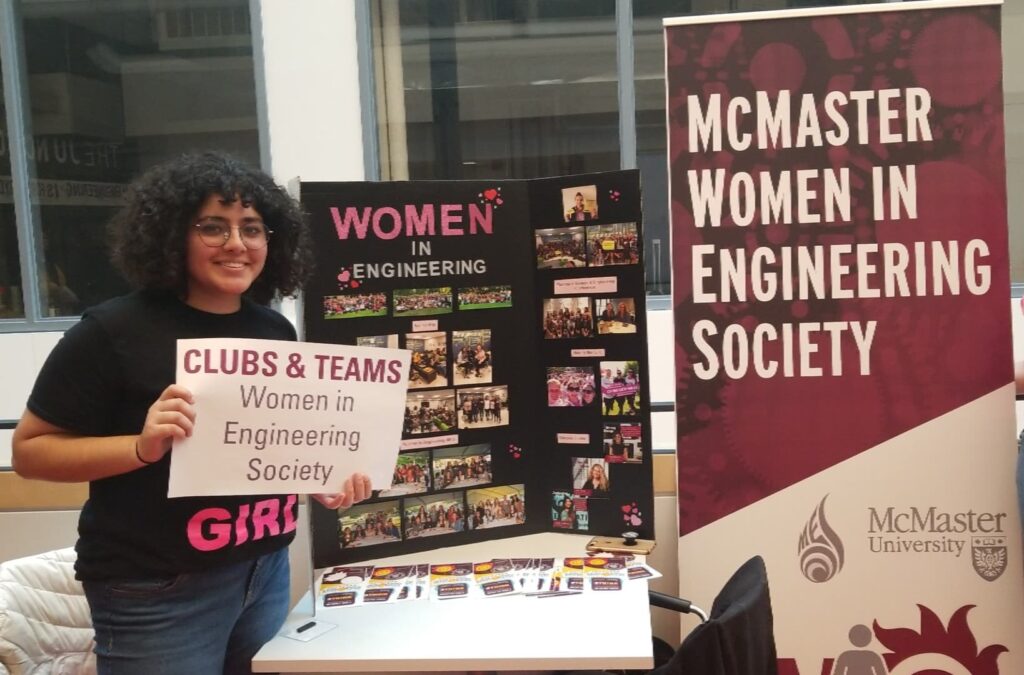
Saher as VP External Relations for the Women in Engineering Society 2018, promoting WiE during Clubs and Teams Fest at McMaster.
The Mac Eng Musical was a huge creative outlet for me. It exposed me to a completely different way of collaborating, alongside students who specialized in acting, singing, and dancing. Even though we were all engineering students, it showed me the value of creativity and teamwork in a multidisciplinary environment. Beyond the memories, it also gave me a strong network that I still draw on today.
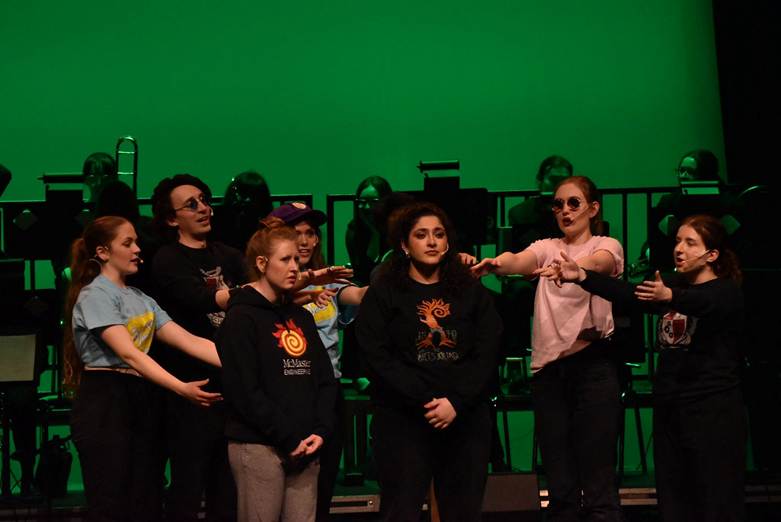
Saher as a cast member in the McMaster Engineering Musical “Hamleng” 2023
You were also involved in nuclear research at McMaster. Can you tell us about that experience and your thoughts on the future of nuclear energy?
My co-op experience was research-based and focused on studying the sorption of radionuclides on different rock types. At the time, Ontario was evaluating potential locations for long-term nuclear waste storage, and this research contributed to understanding which environments would be most viable.
It was a very hands-on experience in a regulated nuclear setting, which taught me a lot about responsibility, safety standards, and how detailed work contributes to much larger decisions. Seeing how my data fed into reports used by national organizations was one of the first times I truly understood how small contributions can have a big impact.
More broadly, I find the future of nuclear energy exciting. New technologies are being developed with safety as the top priority, informed by lessons from past incidents. These systems are becoming more efficient, cost-effective, and reliable, and I think they play an important role in diversifying our energy grid and supporting essential infrastructure.
Was there someone who inspired or mentored you along your journey?
There wasn’t one specific person, but rather a community. I’ve always had a questioning mindset, and through professors, older students, alumni, and peers I met through clubs and teams, I learned by asking questions and listening to others’ experiences.
That sense of community at McMaster made a huge difference. It gave me access to perspectives I wouldn’t have had otherwise, especially as the only engineer in my family. Reaching out to people who had graduated before me and asking for guidance played a big role in shaping my path.
I learned early to keep asking questions—of professors, older students, and peers—because that’s how you really learn and grow.
Why is it important to you to give back through events like Backpack to Briefcase?
Staying connected to McMaster gives me a chance to reflect on how far I’ve come and where I want to go next. Alumni events are also some of the best places to learn, meet professionals, and hear about career paths you might not even know exist.
If you could give advice to your first-year self, what would it be?
I would tell myself not to doubt my abilities or hold back because I didn’t feel good enough. A lot of opportunities felt out of reach simply because of self-doubt.
Co-ops and early roles are designed for learning. You don’t need to be an expert. Being proactive, applying even when you’re unsure, and seeking out opportunities can completely change your career path. Those experiences build momentum and open doors in ways you can’t always predict.
What advice would you give to your newly graduated self?
The uncertainty doesn’t disappear after graduation. The most important thing I’ve learned is to keep reaching out, asking questions, and stay proactive. Many of the connections I made in university eventually led me to where I am now.
It’s something I still practice today, continuing to learn, seek new experiences, and not become complacent. That mindset applies at every stage.
Alumni Blueprints is a Q&A series that highlights the journeys of exceptional McMaster Engineering alumni. Discover how they built their careers, from joining student clubs and teams to seizing co-op opportunities that ignited their passions during their undergraduate years. Our alumni share their unique stories and insights, offering a blueprint for success in their respective fields. Want to share your blueprint for success? Contact the Alumni Team at engalum@mcmaster.ca.