
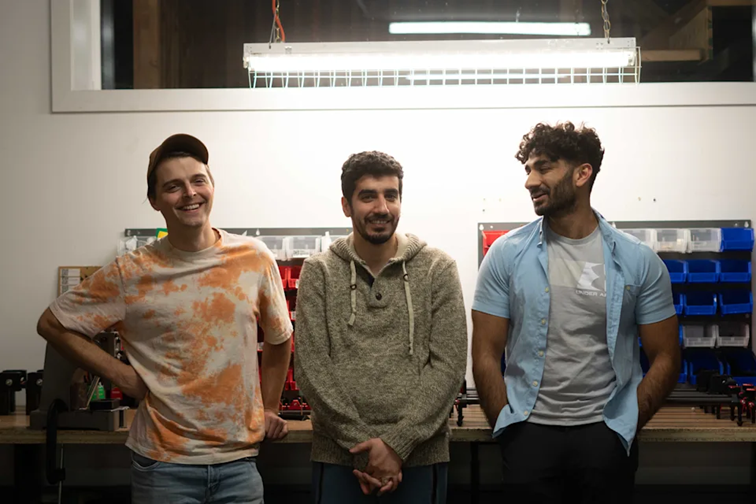
Electrical Engineering alum, Anoop Singh ’20 is the co-founder of AXIBO, a robotics company that began with cinema robotics and has since pivoted toward an ambitious new frontier: humanoid robots designed and built in Canada.
Alongside two fellow Mac Eng alumni, Anoop helped grow AXIBO from a student-led project into a multimillion-dollar company, supplying robotic systems for major film productions and global studios. After scaling the business to significant commercial success, the team made a bold decision to refocus their work on what they believe is one of the most critical technologies of the next decade.
In this Alumni Blueprints Q&A, Anoop reflects on AXIBO’s origin story, the role mentorship played in shaping his career, the importance of choosing meaningful experience over early salary, and his advice for engineering students navigating their first steps after graduation.
Here’s our Q&A with Anoop:
Can you tell us a bit about AXIBO — how it started, where it is today and whether this was something you always wanted to do?
AXIBO was started by three McMaster alumni — two of us from electrical engineering and one from the BTech program. A huge part of how we all met was through Dr. Ishwar Singh. He was really the primary connector and the push behind everything. He did an incredible job of fostering an environment where students could explore their engineering creativity, and we’re very grateful for that.
We all worked together in a lab that Ish created, where we built different robots and worked on hands-on projects. That experience eventually led us to decide, one summer, that instead of taking traditional jobs, we wanted to work full-time on a project we could try to commercialize.
Originally, we were building robotic kits to teach students robotics, but as part of that, we needed to record tutorials. So, we built a robot to film ourselves while we were working. When we looked at that robot, we realized it actually had a higher chance of becoming a commercial product than the kits themselves.
We launched a Kickstarter in 2019 and raised about $100K. Over the next year, we continued developing the product, and at the same time, we took on contract work — anything from app development to custom hardware — to fund the company.
From 2022 to 2024, we scaled that first chapter of AXIBO, which focused on cinema robotics. We grew significantly in volumetric capture and ended up providing robotic systems for Netflix, which became our largest customer. Our work was used on major films like Aquaman and The Flash. In that time, we grew from nothing to about $15M in revenue.
Video showcasing how earlier AXIBO tech was used in filming.
Toward the end of 2024, we made a major pivot. We realized we were operating in a market we weren’t deeply passionate about, and at the same time, we became very concerned about the future of robotics in Canada. Robots are going to be everywhere in the next five years — in homes, factories, schools — and we didn’t see Canada developing strong domestic capabilities in this space.
It felt like a genuinely scary thing that this very critical technology would not have a means of production in Canada.
Robotics is a critical technology, and not having the ability to build it locally felt like relying on another country for electricity. We’re deeply passionate about robotics and about Canada, and that drove us to pivot entirely toward humanoid robotics, with a strong emphasis on being made in Canada.
To move quickly, we raised about $12M in funding, and that’s what we’re working on today.
You founded AXIBO alongside two fellow alumni. How has that partnership evolved over time?
Having co-founders is very much like a marriage. You see these people every day — often more than you see your own family — for years on end. That naturally creates a very deep connection.
We started out as friends who liked working on robots together, and over time, that turned into both a close friendship and a business partnership. There have been ups and downs, but we have a lot of compassion for each other. We’ve gone through major life events together, and that creates a strong bond.
We’re very supportive of one another. If something is happening in one person’s life, the others step up. I honestly couldn’t imagine running a company alone — that would have been incredibly difficult. I’m very grateful for that support system, and I think we all feel the same way.
What are some of your most memorable experiences from your time at McMaster?
Almost everything memorable for me centers around Dr. Ishwar Singh. There weren’t many places at McMaster that truly fostered that level of creativity — where someone would say, “Let’s work on something exciting and cutting-edge.”
You need a professor who’s deeply passionate to instill that mindset in students. Without Ish, I don’t think we would be running a company today, and we probably wouldn’t have had the courage to start one.
Those early years in the lab, building robots and developing a love for engineering creativity, were foundational for everything that came after.
How did your electrical engineering education prepare you for your career path?
Honestly, I don’t have many positive things to say about the program itself in terms of preparing me directly for this path. I had good grades, but I didn’t attend class often, and I didn’t find the coursework particularly useful for what I ended up doing.
That’s not a judgment on whether the program is good or bad — it just wasn’t aligned with this specific path. What was valuable was being surrounded by smart people and being part of an engineering community. That environment mattered a lot.
All of my co-op experience was actually with Dr. Singh — I worked with him for about 16 to 20 months. I wasn’t heavily involved in clubs either, because I was already very busy with the lab and projects we were working on there.
Dr. Singh clearly had a major influence on your journey. What did mentorship mean to you during that time?
Ish actually noticed me because I was riding a very janky electric skateboard around campus. I had been building electric skateboards since high school, and when he saw it, he recognized that I might be passionate about robotics.
From there, he offered me a position to work with him. He didn’t just mentor technical skills — he emphasized collaboration, empathy, and self-awareness. Those lessons became practical tools for leadership and working with people.
Having an environment where both technical and soft skills were nurtured was incredibly important. That mentorship was pivotal to everything we’re doing today.
What advice would you give to engineering students who are starting their careers?
The biggest mistake that I see people making is not valuing quality experience above salary.
I think it’s far more important to ask: What’s the highest-quality experience I can get right now that will put me in a great position five or ten years from now? Many people focus on financial rewards immediately, but that can trap you in a local maximum — something that’s “good enough” but prevents you from reaching something much better.
Early in your career, it’s okay to delay financial gratification in exchange for meaningful experience. That becomes much harder later in life, when responsibilities increase.
As exciting as it is to earn a full-time salary, remember that this is also the time when you can take risks. Your ability to take those risks decreases as you get older.
If you could give advice to your first-year self, what would it be?
I’d tell myself to do more things. First year, I was pretty inactive compared to later years. I could have joined more clubs, taken on more projects, and met more people.
Your goal shouldn’t just be good grades. It should be to collect skills, experiences, and responsibilities. I’d also tell myself to socialize more with other engineers. I stuck closely to friends from high school and didn’t build as many new connections as I could have.
I think I was a bit lazy in first year, if I’m being honest. I would go back and tell myself to push harder — socially and technically.
How do you stay connected to McMaster today, and how would you like to stay involved moving forward?
For a long time, our connection to McMaster was through Ish, but as his role at the university changed, that shifted. Recently, I was back on campus helping to start a new humanoid robotics club, which I believe is called McMaster Humanoid.
We’re helping guide and mentor the group, and that’s something I’m really excited about. Staying connected through initiatives like that is important to me, and I’d love to continue supporting McMaster students in meaningful ways.
Alumni Blueprints is a Q&A series that highlights the journeys of exceptional McMaster Engineering alumni. Discover how they built their careers, from joining student clubs and teams to seizing co-op opportunities that ignited their passions during their undergraduate years. Our alumni share their unique stories and insights, offering a blueprint for success in their respective fields. Want to share your blueprint for success? Contact the Alumni Team at engalum@mcmaster.ca.