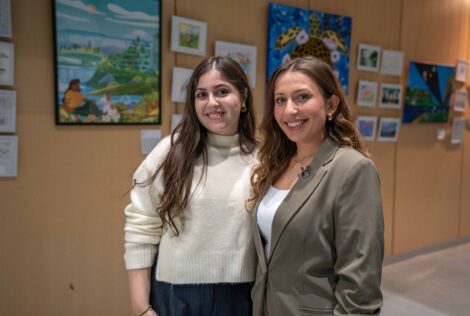

When Sanna Tayabali began her undergraduate journey in Electrical and Biomedical Engineering (iBioMed) at McMaster, she never imagined she’d spend four consecutive summers in California, working on the front lines of surgical robotic design teams. But that’s exactly where her curiosity – and a bold leap into the unknown – led her.
Her first co-op came after just one year of study. She joined a spinal implant company called Surgalign in San Diego, diving into mechanical design for spinal fusion surgeries.
“I was designing screws and implants,” she recalls. “It was a great experience, but what really fascinated me was the testing, working with cadavers, simulating surgeries and collaborating with physicians. I realized how much you need to understand the procedure itself to design effectively for it.”
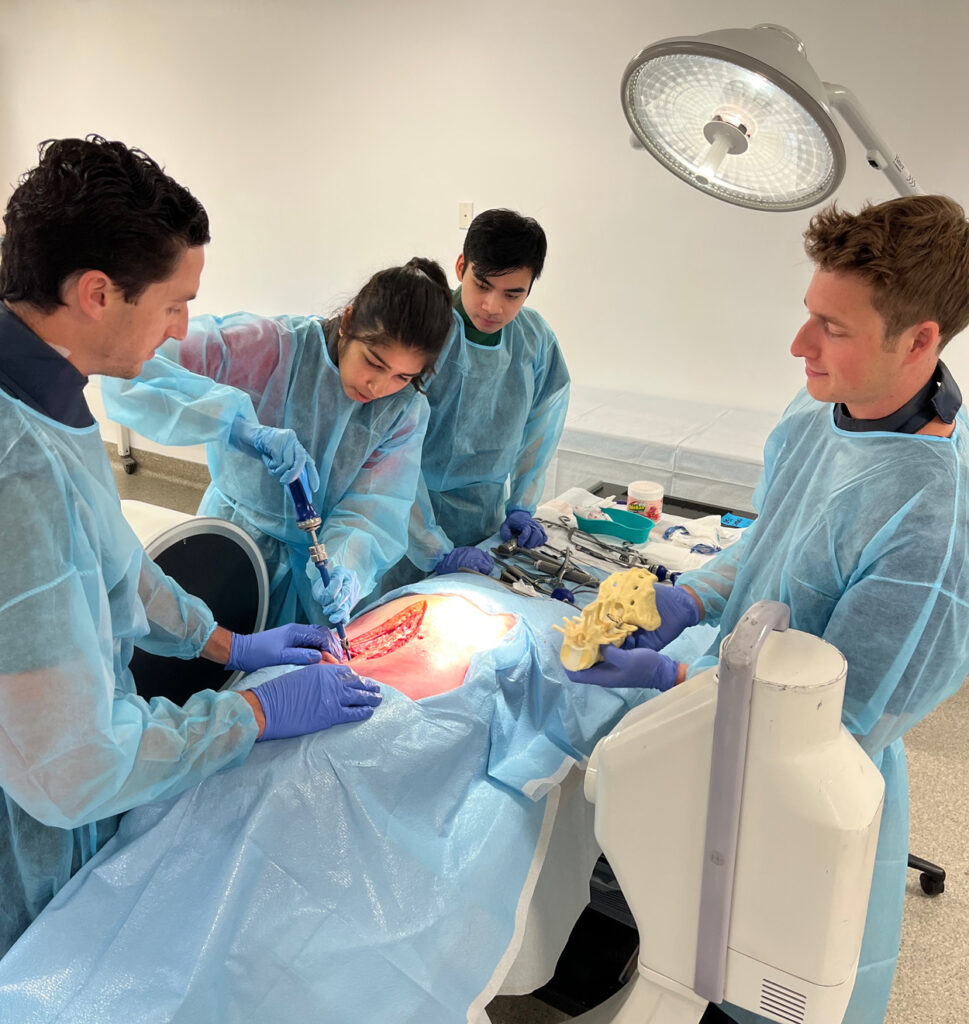
That experience sparked a passion for the intersection of engineering and medicine. Sanna discovered a niche role called clinical engineering – an uncommon but critical position in surgical robotics. Clinical engineers act as the bridge between research and development teams and surgeons, translating clinical needs into engineering requirements. “You’re the person who understands what the device needs to do from a clinical perspective and communicates that to the engineering teams,” she explains.
Through a mix of research and networking, Sanna found her way to a 10-person startup in San Francisco called Petal. It was her first hands-on experience in clinical engineering, and it confirmed she was on the right path. From there, her sights were set on Intuitive – the company behind the da Vinci Surgical System and a pioneer in robotic surgery.
“They basically created the clinical engineering role,” she says.
Their training program is incredible, and I spent most of my time in fully equipped operating room labs, using the system and testing vision technologies.
This summer, she’s continuing her journey at Johnson & Johnson’s MedTech division, working on next-generation robotic technology. “It’s early-stage, but that’s what makes it exciting. You’re shaping the foundation,” she says.
Sanna’s love for clinical engineering stems from her ability to zoom out and see the big picture. “I like talking to people. I like understanding how a system fits into meeting real human needs,” she says. “You’re watching surgical videos, observing procedures and figuring out how to make them better. It’s about improving outcomes for patients and making surgeons’ lives easier.”
Despite not using much of her electrical engineering training day-to-day, she values the foundation it gives her. “It helps me understand what’s realistic to ask of an engineering team. I want to be someone who can bridge the gap between disciplines.”
Back at McMaster, Sanna has been involved in the Exoskeleton Design Team and served as a Red Suit student ambassador during Welcome Week. She’s also heading into her capstone year with a team of friends who, like her, are spending the summer in the Bay Area. “California doesn’t feel far from home anymore,” she says. “There’s a whole community of McMaster students and alumni here.”
To incoming students, her advice is simple: keep an open mind. “I was a type-A planner with a five-year vision board. None of it happened the way I thought, but what did happen was better.” She encourages students to apply for roles even if they don’t feel fully qualified. “I got my first job by demonstrating what I learned from my first-year design project and showing a willingness to learn quickly. People care about your attitude more than you think.”
As she looks ahead to life after McMaster, Sanna sees clinical engineering as a launchpad to other exciting pathways.
It’s a great place to start. You get to touch development, business, safety and strategy. From here, I’m excited to see where this journey will take me next.