

Overview
Discover how information geometry unlocks new ways to understand probability, statistics, and Markov processes.
This lecture will explore fundamental concepts and cutting-edge research at the intersection of mathematics, statistics, and information theory—offering insights that bridge theory and practical application.
Abstract
Information geometry is a framework for studying the structure of “information” through the lens of differential geometry. It has broad applications in statistics, information theory, and physics.
This talk will begin with a review of fundamental concepts—such as the e-family, m-family, and the Pythagorean identity—in the context of probability distributions, without requiring prior knowledge of differential geometry. Prof. Watanabe will then introduce an application of information geometry to statistical hypothesis testing and extend these concepts to Markov kernels.
The presentation will conclude with Prof. Watanabe’s recent findings that the set of reversible Markov kernels constitutes both e-family and m-family structures. This talk is based on joint work with Geoffrey Wolfer.
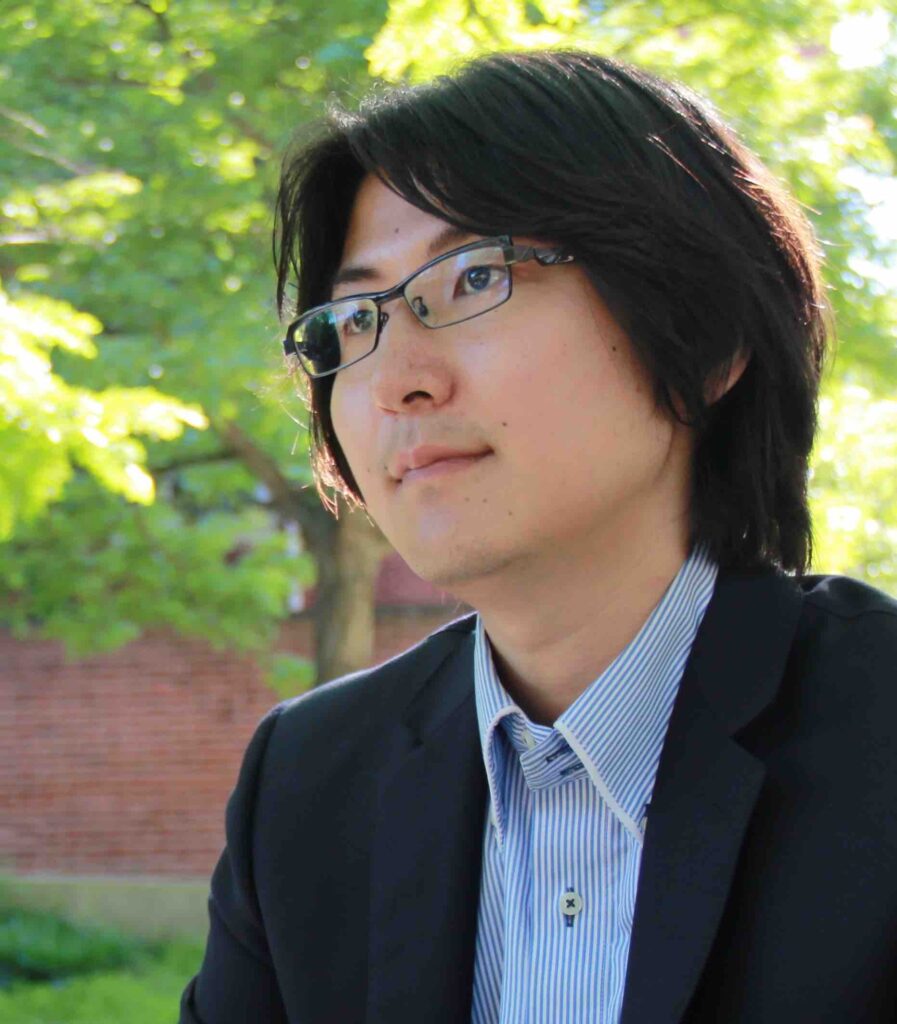
About the Speaker
Shun Watanabe earned his B.E., M.E., and Ph.D. degrees from the Tokyo Institute of Technology in 2005, 2007, and 2009, respectively.
From 2009 to 2015, he served as an assistant professor at the University of Tokushima and was a visiting assistant professor at the University of Maryland from 2013 to 2015. He is currently an associate professor at the Tokyo University of Agriculture and Technology.
Prof. Watanabe has held notable leadership roles, including:
- Associate Editor for the IEEE Transactions on Information Theory (2016–2020)
- General Co-Chair of the 2021 IEEE Information Theory Workshop
- Member of the Board of Governors of the IEEE Information Theory Society (2022–2024)
- IEEE Information Theory Society Distinguished Lecturer (2023–2024)
His research focuses on information theory, coding, and their applications.
Who Should Attend?
This lecture will be of interest to:
- Anyone interested in statistical methods, Markov processes, or the mathematics of information
- Graduate students and researchers in electrical and computer engineering, mathematics, statistics, and physics
- Industry professionals working in data science, information theory, and probabilistic modeling